The Ultimate Guide to Investing How to Build Generational Wealth from Scratch
For the majority of the working population, the financial blueprint for life has been passed down through generations as a simple, unquestioned formula: go to school, get a secure job, work hard for forty years, save a portion of your salary in a bank account, and eventually retire. However, in the modern economic landscape, this traditional formula is fundamentally broken. Earning a high salary and saving your money in a traditional bank is no longer a path to financial freedom; it is a mathematical guarantee of losing your purchasing power over time.
The missing component in this traditional blueprint is the concept of Investing. Investing is not gambling, it is not a get-rich-quick scheme, and it is not an exclusive club reserved for Wall Street elites. At its core, investing is the deliberate act of putting your capital to work so that it generates more capital, completely independent of your physical labor.
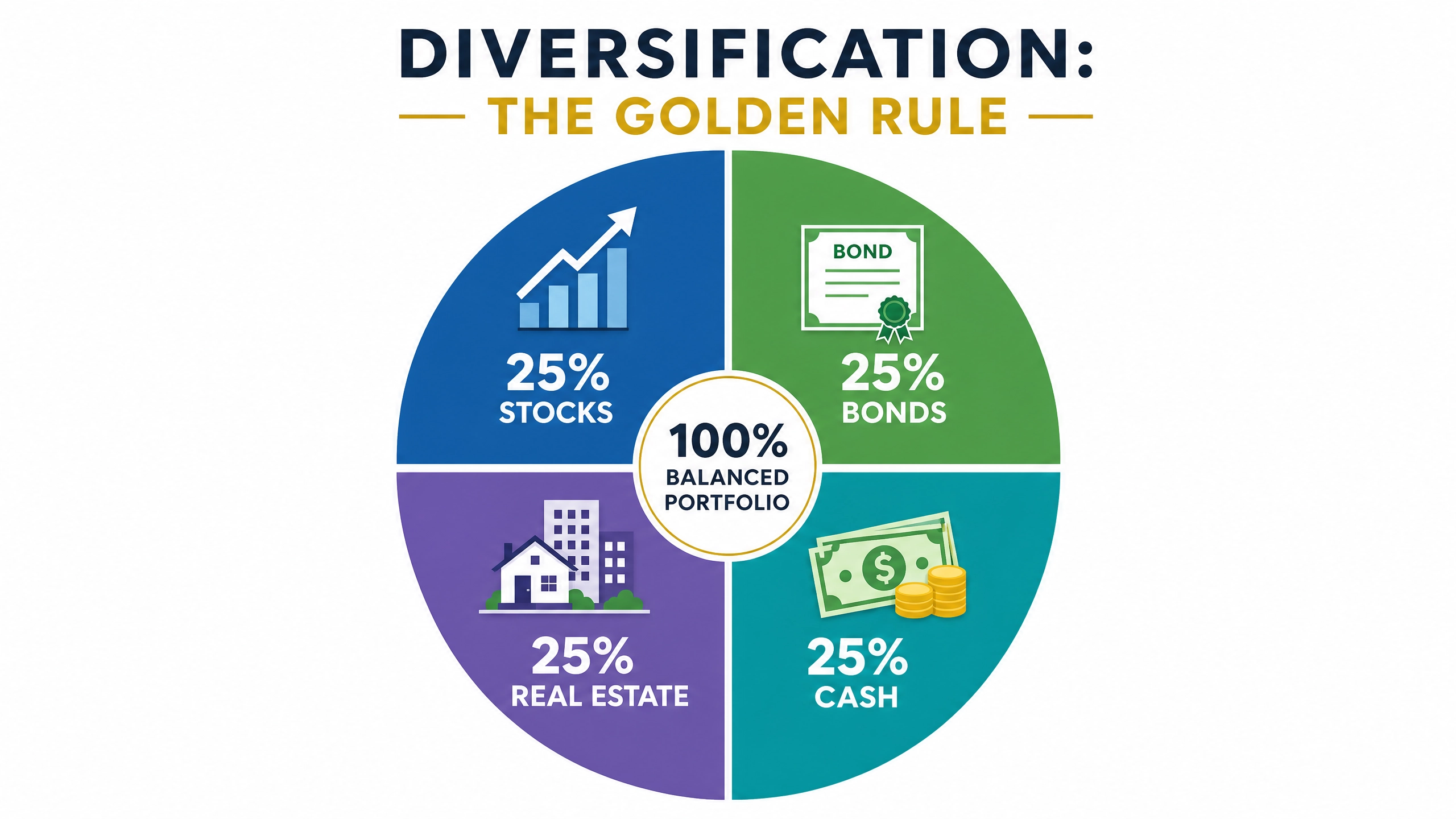
If you want to achieve true financial independence—the point where your passive income covers your living expenses and working becomes optional—you must transition your mindset from being a consumer to becoming an owner. This comprehensive guide will demystify the complex world of global markets, break down the various asset classes, explain the unparalleled mathematics of compound interest, and provide you with a step-by-step framework to begin building generational wealth today.
1. The Core Philosophy: Why You Must Invest to Survive
Before diving into stocks, bonds, and real estate, it is vital to understand why investing is not optional. If you simply hoard your cash under a mattress or in a standard checking account, you are falling victim to the silent thief of the financial world: Inflation.
The Silent Thief: Inflation
Inflation is the steady, gradual increase in the price of goods and services over time. Historically, inflation averages around 2% to 3% per year. This means that if you have $100,000 sitting in a checking account today, in ten years, that exact same money will only have the purchasing power of roughly $74,000. Your money is slowly bleeding value every single day. Investing is the only reliable shield against inflation. By buying assets that grow in value faster than the inflation rate, you preserve and expand your true purchasing power.
The Magic of Compound Interest
Albert Einstein famously referred to compound interest as the “eighth wonder of the world,” stating that “He who understands it, earns it; he who doesn’t, pays it.”
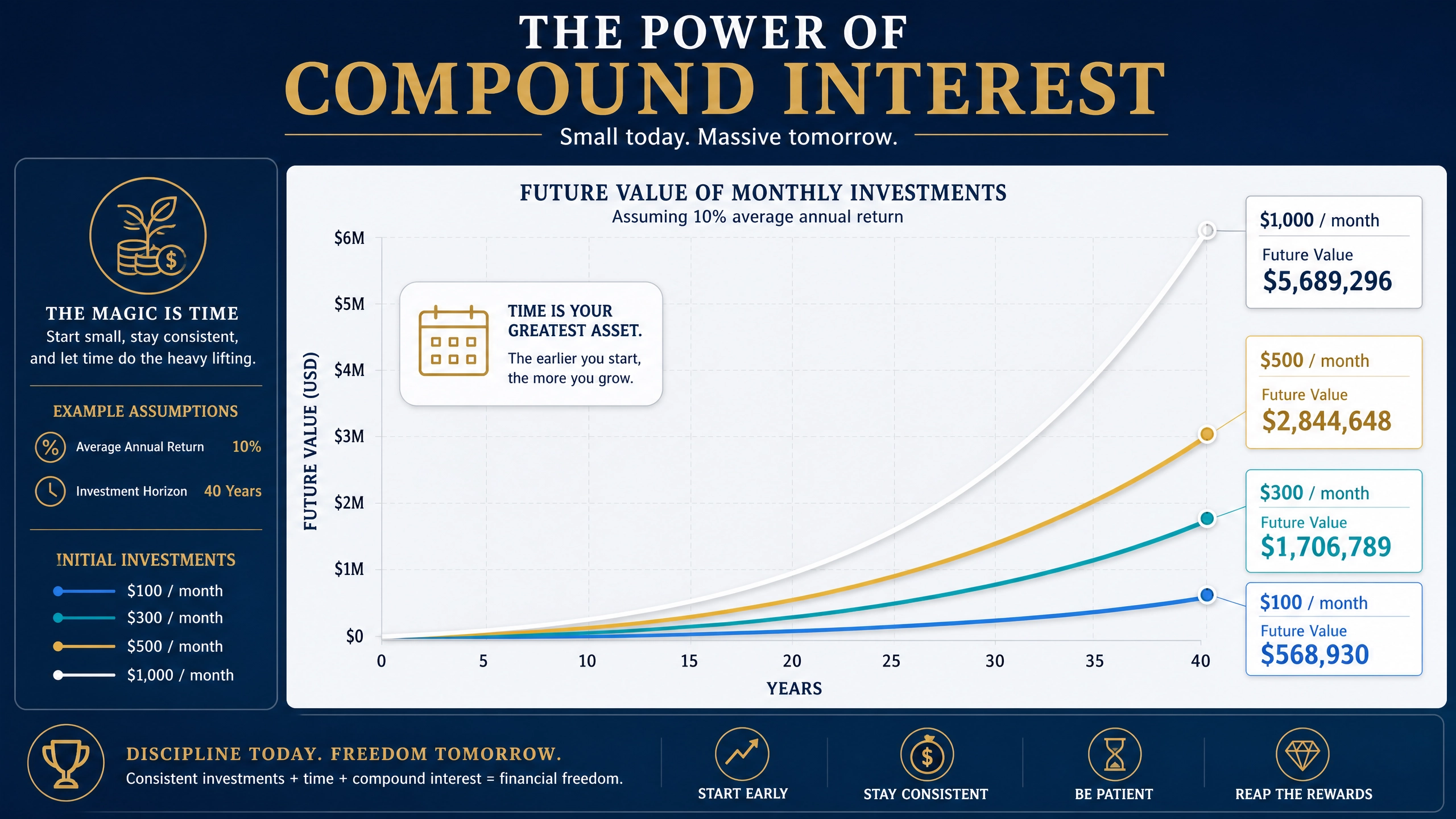
Compound interest is the process of earning interest on your original investment, and then earning interest on the new interest you just generated. It creates an exponential snowball effect. For example, if you invest $500 a month into an asset that returns a historical average of 8% annually, you will have contributed $180,000 of your own money over 30 years. However, thanks to the exponential power of compounding, your total account balance will be over $745,000. The market generated over half a million dollars of free wealth for you simply because you gave your money the time to grow.
2. Preparing the Foundation (Before You Invest)
One of the most catastrophic mistakes novice investors make is jumping into the stock market before their financial house is in order. Investing without a foundation is like building a skyscraper on quicksand. You must complete two prerequisites before buying your first stock.
Prerequisite 1: The Emergency Fund Mandate
The stock market is volatile. It will experience crashes, corrections, and bear markets. If you experience a personal crisis (like a job loss or a medical emergency) while the market happens to be crashing, and you do not have liquid cash, you will be forced to sell your investments at a massive loss just to survive. Before investing, you must build an emergency fund consisting of 3 to 6 months of bare-bones living expenses housed safely in a High-Yield Savings Account (HYSA). This cash acts as a defensive moat, protecting your investments from being liquidated prematurely.
Prerequisite 2: Eliminating Toxic High-Interest Debt
If you have $5,000 in credit card debt charging a 24% Annual Percentage Rate (APR), and you invest $5,000 in the stock market expecting an 8% return, you are mathematically moving backward by 16% every year. You cannot out-invest toxic, high-interest consumer debt. Any debt with an interest rate higher than 7% (credit cards, personal loans, some auto loans) must be ruthlessly eliminated before you direct your capital toward the markets.
3. Decoding the Asset Classes: Where Does Your Money Go?
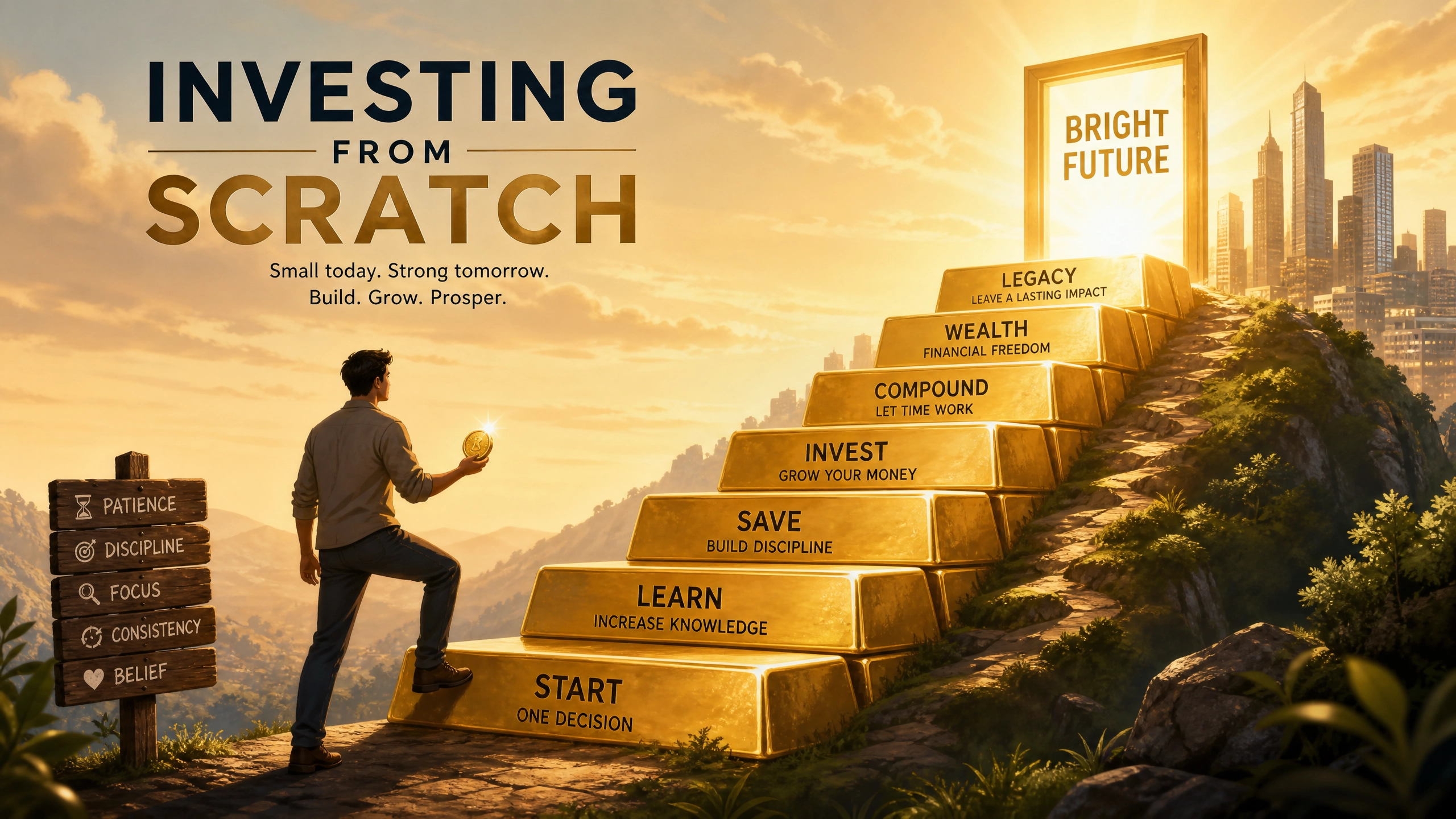
When you decide to invest, you are essentially buying a specific type of asset. The global financial market is divided into several primary asset classes, each carrying a different risk and reward profile.
Equities (The Stock Market)
When you buy a stock, you are buying a fractional ownership stake in a real, functioning business. If you buy a share of Apple, you own a tiny piece of their factories, their intellectual property, and their future profits.
- How you make money: Through capital appreciation (the stock price goes up) and Dividends (the company distributes a portion of its cash profits directly to shareholders).
- Risk Profile: High volatility in the short term, but historically offers the highest returns over long periods (averaging 9% to 10% annually over the last century).
Fixed Income (Bonds)
When you buy a bond, you are acting as the bank. You are lending your money to a corporation or a government (like the U.S. Treasury) for a set period. In exchange, they promise to pay you a fixed interest rate every year and return your original capital when the bond matures.
- Risk Profile: Low volatility, low risk, but generally lower returns (averaging 3% to 5%). Bonds are used to stabilize a portfolio and provide predictable income.
Real Estate
Investing in real estate involves acquiring physical land and property. You generate wealth through tenant rental income and the natural appreciation of the property value over decades. For those who do not want to manage physical properties or deal with leaky roofs, you can invest in Real Estate Investment Trusts (REITs), which are companies that own income-producing real estate that you can buy and sell on the stock market just like regular shares.
Commodities and Alternative Assets
This class includes physical assets like Gold, Silver, Oil, Agricultural products, and modern digital assets (Cryptocurrency). These assets do not produce cash flow or pay dividends; their value is derived entirely from supply and demand. They are typically used as hedges against inflation or currency devaluation rather than primary growth engines.

4. The Investment Vehicles: How to Buy the Market
Understanding what to buy is crucial, but understanding how it is packaged is equally important. You do not have to pick individual companies to be a successful investor.
The Danger of Individual Stock Picking
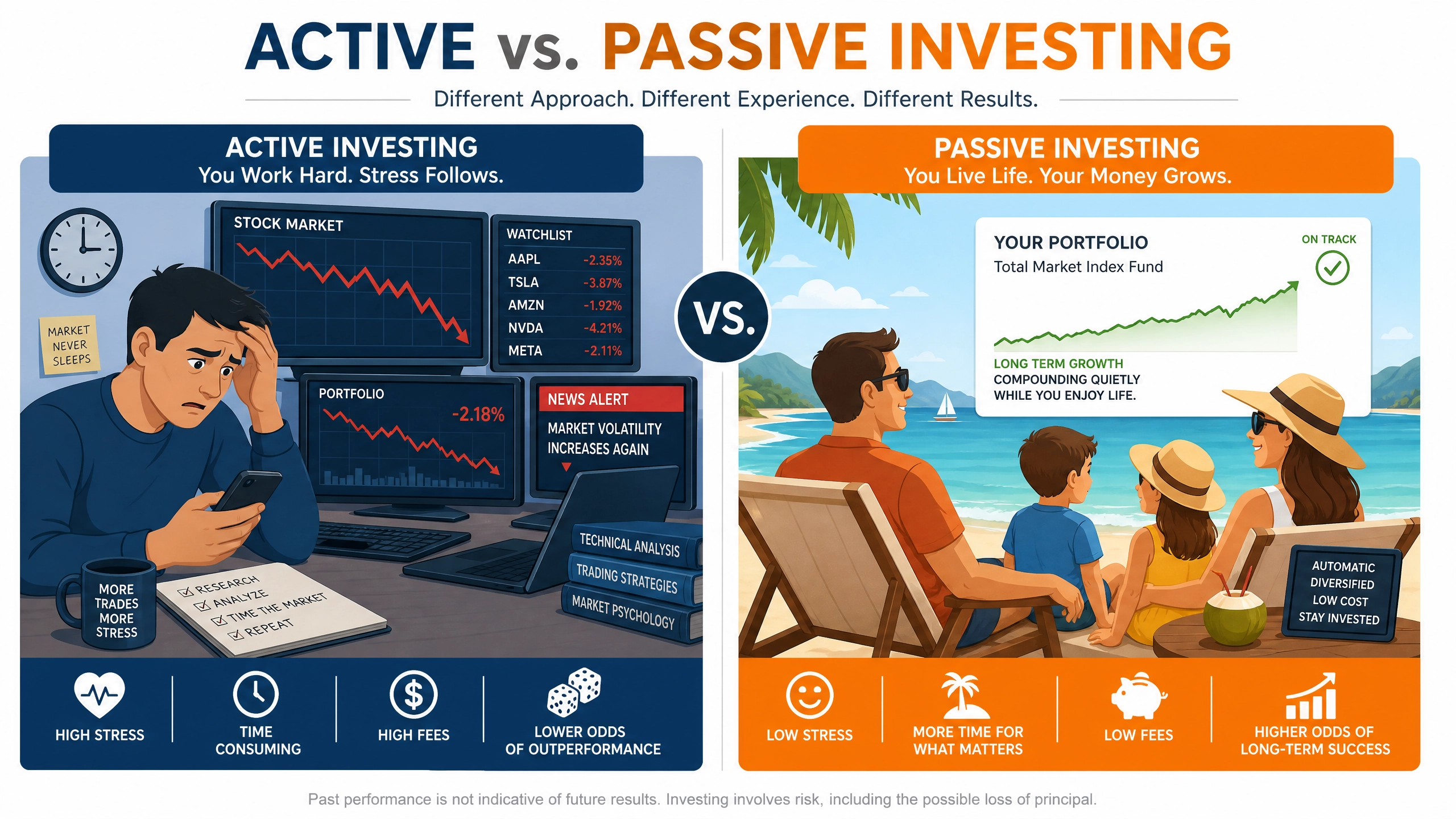
Many beginners open a brokerage account and try to guess which company will be the next Amazon or Tesla. This is a highly risky strategy. Even professional Wall Street fund managers with armies of analysts fail to beat the broader market consistently over ten-year periods. If you put all your money into a single company and that company goes bankrupt (like Enron or Blockbuster), your capital goes to absolute zero.
Mutual Funds
A mutual fund pools money from thousands of investors and pays a professional manager to actively pick a portfolio of stocks or bonds. While this provides diversification, actively managed mutual funds often charge exorbitant fees (known as the Expense Ratio). An expense ratio of 1.5% might sound small, but it can consume hundreds of thousands of dollars of your potential compound growth over a thirty-year horizon.
The Reign of the Index Fund and ETF (Exchange Traded Fund)
This is the holy grail for the everyday investor. An index fund does not try to “beat” the market; it simply buys a tiny piece of every company in a specific index. For example, an S&P 500 Index Fund automatically buys a sliver of the 500 largest publicly traded companies in the United States (Apple, Microsoft, Google, Johnson & Johnson, etc.).
- The Advantage: Instant, massive diversification. If one company fails, the other 499 carry your portfolio.
- The Cost: Because there is no highly paid manager picking stocks, the fees are microscopic (often around 0.03%). Legendary investor Warren Buffett has consistently stated that a low-cost S&P 500 index fund is the absolute best investment for 99% of people.
5. Strategic Tax-Advantaged Accounts (Maximizing Returns)
In investing, it is not just about what you make; it is about what you keep. The government wants you to save for retirement, so they created specialized “buckets” or accounts that offer massive legal tax shields. You should always maximize these accounts before investing in a standard, taxable brokerage account.
The 401(k) / Employer-Sponsored Plan
Offered by your employer, money is deducted from your paycheck before taxes are calculated, lowering your current tax burden. The money grows tax-deferred until you withdraw it in retirement.
- The Employer Match: Many companies offer a “match” (e.g., they will match your contributions up to 5% of your salary). This is a 100% guaranteed, instant return on your money. Never, ever leave the employer match on the table. It is literally free money.
The IRA (Individual Retirement Account)
This is an account you open yourself through brokerages like Vanguard, Fidelity, or Charles Schwab.
- Traditional IRA: Contributions are tax-deductible today, but you pay ordinary income taxes when you withdraw the money in retirement.
- Roth IRA: You contribute money you have already paid taxes on today. The money grows completely tax-free, and when you withdraw it in retirement, the government cannot touch a single penny of your massive compounded growth. (The Roth IRA is widely considered the ultimate wealth-building tool for the middle class).
6. Risk Tolerance and Asset Allocation
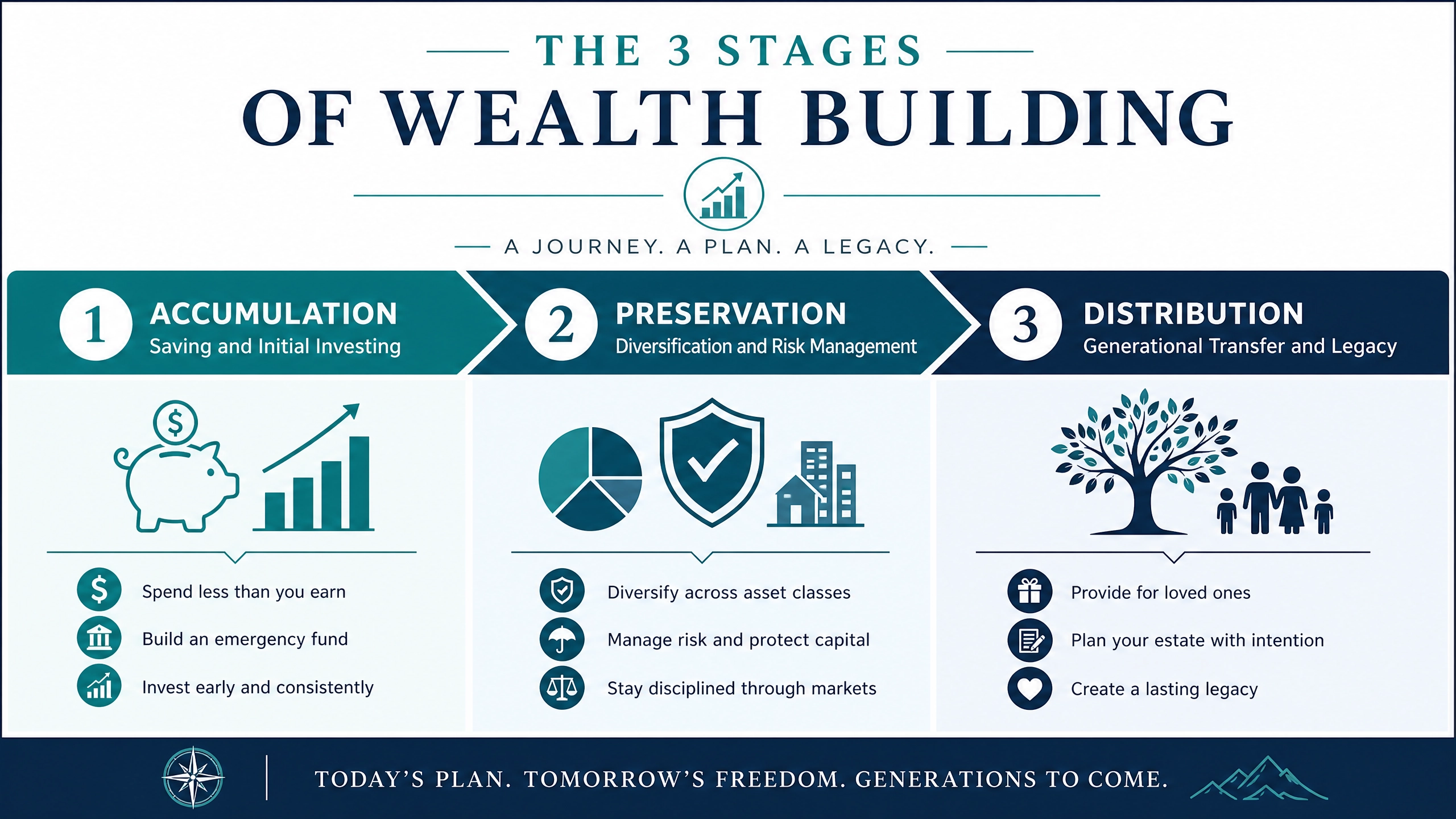
Asset allocation is the exact percentage breakdown of your portfolio between different asset classes (e.g., 80% Stocks, 20% Bonds). Your ideal allocation is determined entirely by your Time Horizon and your Risk Tolerance.
The Time Horizon Rule
If you are 25 years old and investing for retirement at 65, you have a 40-year time horizon. You can afford to take massive risks because you have decades to recover from market crashes. Your portfolio should be heavily skewed toward aggressive growth (e.g., 90% to 100% Equities). If you are 60 years old and retiring in five years, a 30% market crash would be devastating. Therefore, you must shift your allocation toward safety and income (e.g., 60% Bonds, 40% Equities).
The “110 Rule” of Thumb
A classic, simplified strategy to determine your stock allocation is to subtract your age from 110.
- If you are 30 years old: 110 – 30 = 80. You should hold 80% stocks and 20% bonds.
- If you are 50 years old: 110 – 50 = 60. You should hold 60% stocks and 40% bonds.

7. The Golden Rules of Market Psychology
The mathematical mechanics of investing are actually quite simple. The reason most people fail to build wealth is not a lack of intelligence; it is a lack of emotional control. Human psychology is hardwired to do the exact opposite of what makes money in the stock market. We are driven by fear and greed.
Time in the Market vs. Timing the Market
Novice investors constantly try to guess when the market has hit the “bottom” to buy, or when it has hit the “top” to sell. This is impossible to predict consistently. Historical data proves that missing just the 10 best trading days in a decade will slash your overall returns by over 50%. The most successful investors buy consistently, hold through the terrifying crashes, and never attempt to time the market.
Dollar-Cost Averaging (DCA)
The ultimate psychological defense mechanism is Dollar-Cost Averaging. This means investing a fixed amount of money at a regular interval, regardless of what the market is doing. If you commit to investing $500 on the 1st of every month:
- When the market is booming, your $500 buys fewer shares.
- When the market crashes and everyone is panicking, your $500 automatically buys more shares at a massive discount. DCA removes all emotion from investing, turning market crashes into automated buying opportunities.

8. Comparative Matrix: Investment Strategies Overview
Use this reference table to understand the pros and cons of different investment architectures before allocating your capital.
| Investment Vehicle | Primary Advantage | Primary Vulnerability | Effort Level | Ideal Investor Profile |
|---|---|---|---|---|
| Broad Market Index Funds / ETFs | Ultimate diversification, microscopic fees, historical reliability. | Cannot “beat” the market; you will only match the market average. | Very Low (Set & Forget) | 99% of all long-term wealth builders and retirement savers. |
| Individual Stocks | Potential for massive, exponential returns if the company succeeds. | High risk of permanent capital loss; immense volatility. | Very High (Requires heavy research) | Experienced investors using only a small, speculative portion of their portfolio. |
| Bonds (Treasuries/Corporate) | Guaranteed capital preservation; predictable passive income yields. | Returns rarely beat long-term inflation; low growth potential. | Low | Retirees seeking income; conservative investors nearing withdrawal phases. |
| Physical Real Estate | Tangible asset; generates monthly cash flow; utilizes leverage (mortgages). | High barrier to entry (down payments); dealing with tenants and maintenance. | High (Active Management) | Individuals looking to build a business empire and generate current monthly income. |

9. Frequently Asked Questions (FAQ)
How much money do I need to start investing?
Zero. In the past, brokerages charged high commissions and required $3,000 minimums just to open an account. Today, thanks to financial technology, major brokerages (like Fidelity or Vanguard) offer zero-commission trading and allow you to buy “fractional shares.” You can literally start investing in the S&P 500 today with just $10.
What happens if the stock market crashes to zero?
If a broad market index like the S&P 500 crashes to absolute zero, it means the 500 largest companies in America—including the banks, the grocery stores, the energy grids, and the tech infrastructure—have completely ceased to exist. If this apocalyptic scenario occurs, your stock portfolio will be the least of your concerns; you will be worried about finding clean water and canned food. The market has survived World Wars, pandemics, and depressions, and it has always recovered to reach new all-time highs.
Is cryptocurrency a good investment?
Cryptocurrency (like Bitcoin or Ethereum) is a highly speculative, highly volatile alternative asset. Unlike stocks (which represent real businesses) or real estate (which generates rental income), crypto produces no cash flow. While it has generated massive returns for early adopters, it should not be the foundation of your portfolio. If you choose to invest in crypto, financial advisors generally recommend limiting it to 1% to 5% of your total net worth.
Should I hire a financial advisor?
If your financial situation is relatively simple (you have a W2 job, some debt, and want to save for retirement), a traditional financial advisor who charges a 1% to 2% annual Asset Under Management (AUM) fee is usually an unnecessary expense that will drain your compound growth. You can easily manage a simple 3-fund index portfolio yourself. You only need a specialized fiduciary advisor when your net worth becomes highly complex (multiple businesses, massive estates, complex tax structuring).
Author’s Note: The First Step is the Hardest
The world of investing is deliberately filled with confusing jargon—derivatives, expense ratios, bearish divergence, and yield curves. The financial industry makes it sound incredibly complicated because that is how they justify charging you massive fees to manage it for you.
Do not let the terminology intimidate you. Building wealth is not a complex puzzle; it is a remarkably simple, albeit slow, process of discipline.
The greatest threat to your financial future is not picking the wrong stock; it is the paralysis of analysis. Waiting for the “perfect time” to invest is a fool’s errand. The perfect time was twenty years ago; the second best time is today.
Open a brokerage account, set up an automatic monthly transfer, buy a low-cost S&P 500 index fund, and absolutely refuse to look at the daily financial news. Let the relentless, churning engine of global commerce do the heavy lifting for you. Give your money time, ignore the panic, and watch as you slowly construct an unshakeable fortress of financial freedom for yourself and the generations that will follow you.