How Credit Scores Work: Decoding the Blueprint of Your Financial Identity
If you live within the modern financial ecosystem, there is a three-digit number attached to your name that silently dictates the trajectory of your life. It determines whether a bank will trust you with a mortgage for your dream home, what interest rate you will pay for your car, whether a landlord will rent you an apartment, and sometimes, whether an employer will offer you a job.
Despite its omnipresent influence, the credit score remains deeply misunderstood by the vast majority of consumers. Many people view it as a subjective judgment on their character or a mysterious number generated by an arbitrary, hidden algorithm.
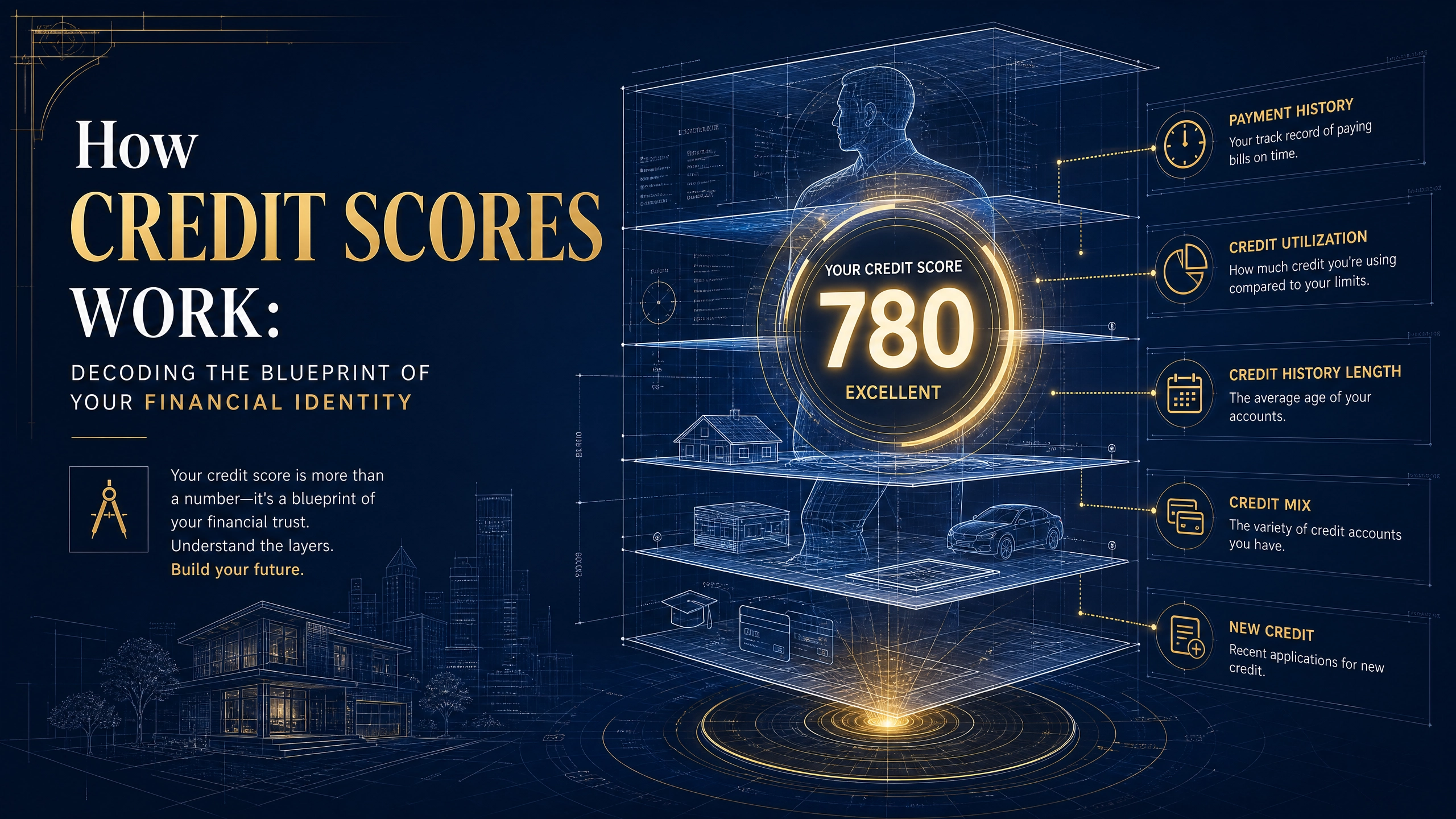
The reality is far less mystical and far more mathematical. A credit score is a highly structured, objective calculation designed to answer a single question for lenders: “If I lend this person money today, what is the statistical probability that they will pay me back on time?”
Understanding how this calculation works is the fundamental prerequisite to financial freedom. This comprehensive guide will demystify the entire credit reporting industry. We will break down the exact mathematical components of the FICO score, explain how the major credit bureaus collect your data, debunk the most dangerous myths that cost consumers thousands of dollars, and provide a clear roadmap to engineering a perfect credit profile.
1. The Architects of the System: Bureaus and Scoring Models
To understand your credit score, you must first understand the entities that build it. The system is fundamentally divided into two distinct parts: the data collectors and the math equations.
The Data Collectors: The Three Major Credit Bureaus
There are three primary credit reporting agencies (bureaus) in the United States: Experian, Equifax, and TransUnion.
These private, for-profit companies do not calculate your official score. Their sole job is to act as massive digital libraries. They collect data from your banks, credit card issuers, and lenders regarding your financial behavior. They compile this raw data into a document called your Credit Report. Think of your credit report as your raw financial transcript.
The Math Equations: FICO vs. VantageScore
Once the bureaus have your raw transcript, a scoring model is applied to that data to generate the final three-digit grade.
- FICO (Fair Isaac Corporation): Created in 1989, this is the absolute gold standard of the industry. Over 90% of top lenders use the FICO scoring model to make lending decisions. If you are applying for a mortgage, the bank is looking at your FICO score.
- VantageScore: Created jointly by the three bureaus to compete with FICO. It is the score you typically see when you use free credit monitoring apps like Credit Karma. While helpful for tracking general trends, it is rarely the score a serious lender uses.
Important Note: Because lenders report data to the three bureaus at different times, and because some lenders only report to one or two bureaus instead of all three, your credit report at Experian might look slightly different than your report at TransUnion. Consequently, you actually have three different FICO scores, one based on each bureau’s data.

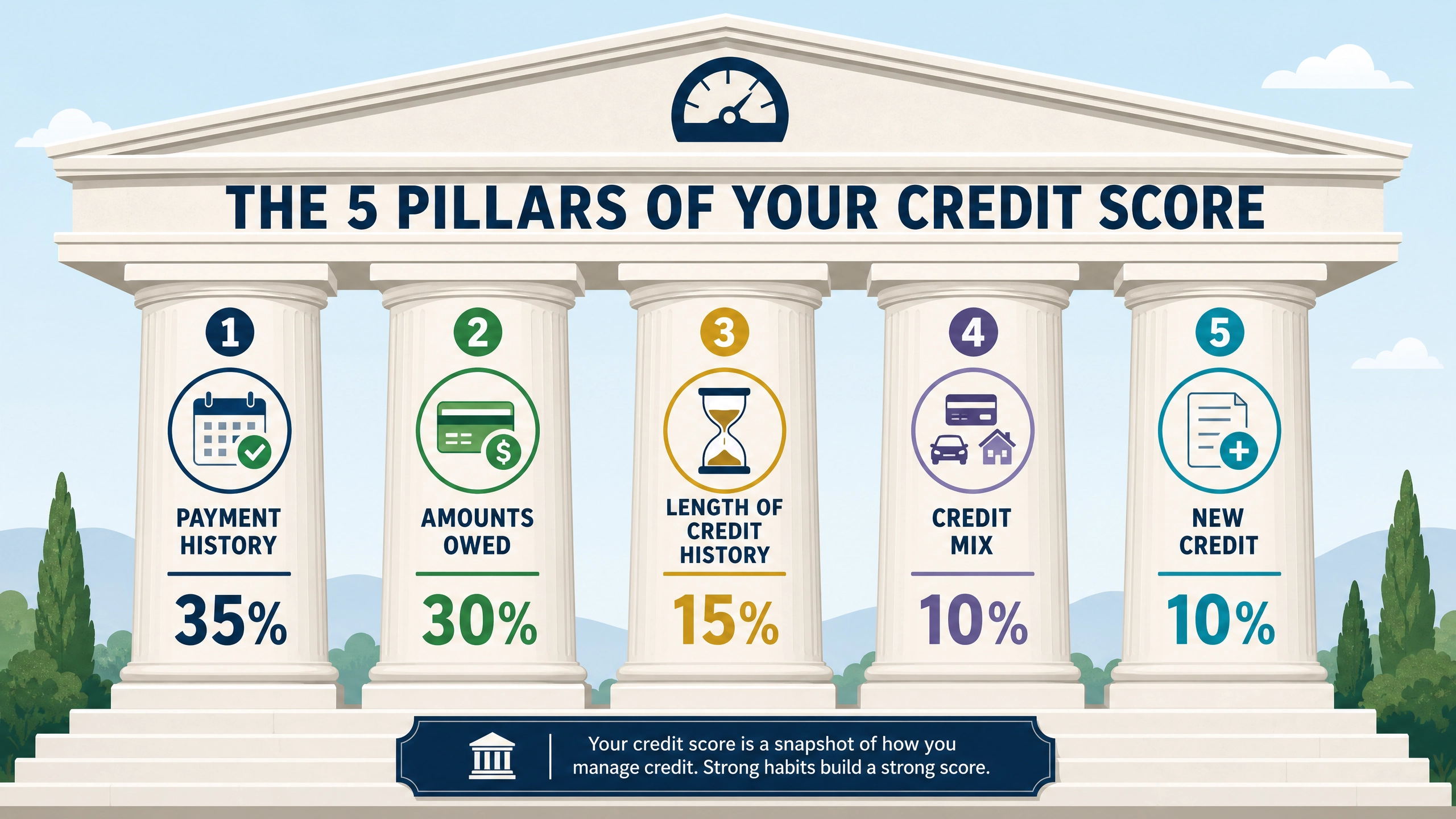
2. The Anatomy of a FICO Score: The Five Pillars
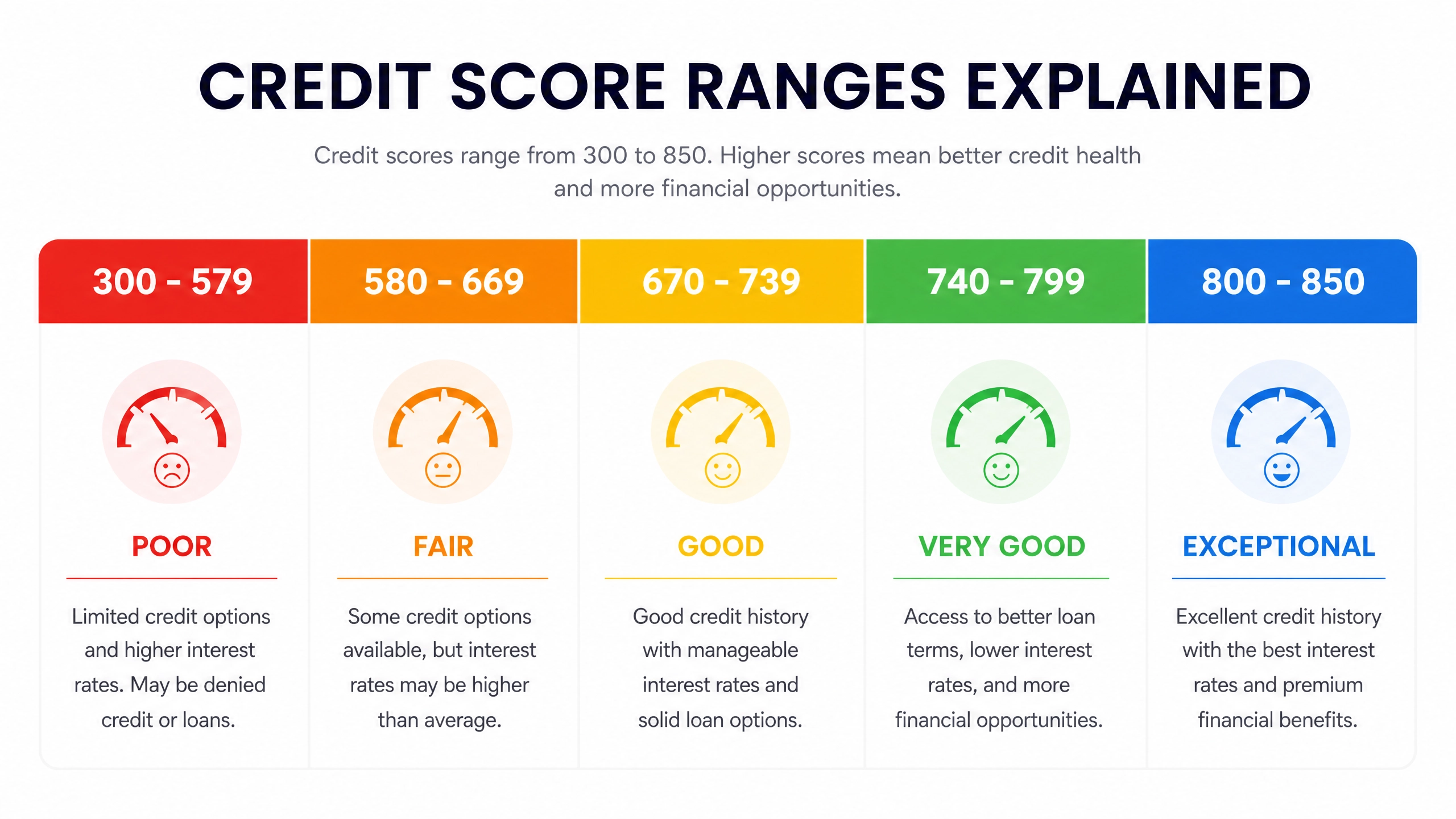
The FICO scoring model ranges from 300 (Exceptionally Poor) to 850 (Exceptional). The algorithm that calculates this number is completely transparent. It is divided into five weighted categories. If you want to optimize your score, you must understand exactly how the algorithm weighs your actions.
1. Payment History (35% of Total Score)
This is the single heaviest factor in your credit score. Lenders care more about your past reliability than anything else.
- What it tracks: Whether you have paid your credit cards, auto loans, student loans, and mortgages on time.
- The Impact: The algorithm is incredibly unforgiving. A single payment reported 30 days late can instantly drop a pristine 800 credit score by 80 to 100 points. Accounts sent to collections, foreclosures, and bankruptcies are catastrophic to this category and will scar your report for 7 to 10 years.
- The Goal: 100% on-time payments, automated every single month.
2. Amounts Owed / Credit Utilization (30% of Total Score)
Lenders are terrified of borrowers who appear desperate for cash. This category looks at how much debt you are carrying, but more importantly, it measures your Credit Utilization Ratio.
- What it tracks: How much of your available revolving credit (credit cards) you are actively using. If you have a total credit limit of $10,000 and a balance of $5,000, your utilization is 50%.
- The Impact: Maxing out your credit cards signals financial distress, and the algorithm will penalize your score brutally.
- The Goal: Keep your overall credit utilization strictly below 10%, and preferably between 1% and 5% for maximum point optimization.
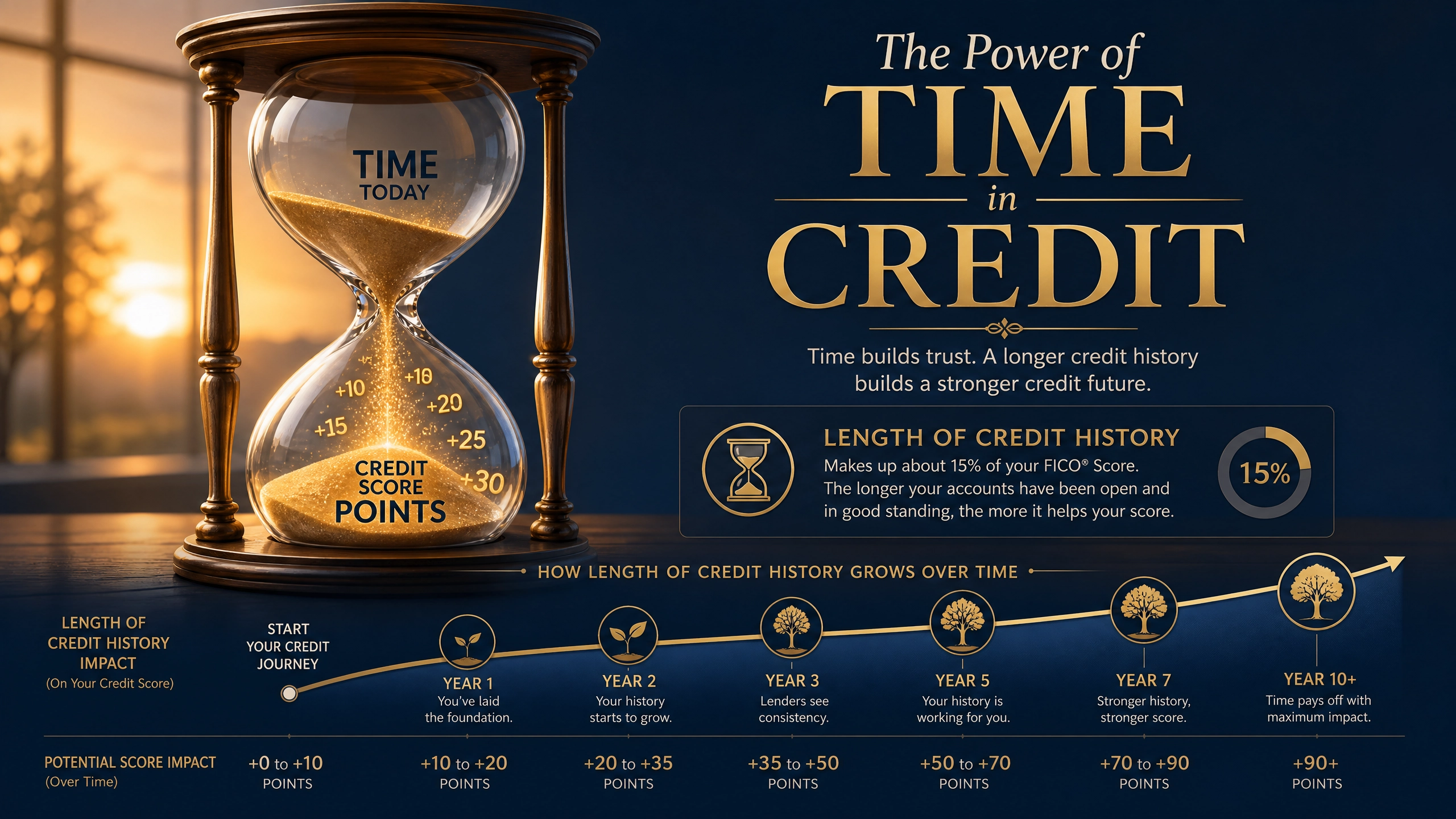
3. Length of Credit History (15% of Total Score)
Data science relies on sample sizes. A lender trusts a borrower with a 15-year track record of good behavior significantly more than a borrower who opened their first credit card three months ago.
- What it tracks: The age of your oldest account, the age of your newest account, and the average age of all your accounts combined.
- The Impact: This category is why closing your oldest credit card is a terrible financial mistake. Closing an old account eventually wipes out years of positive history, lowering the average age of your profile.
- The Goal: Keep your oldest, no-annual-fee credit cards open forever, using them once a year to prevent inactivity closure.
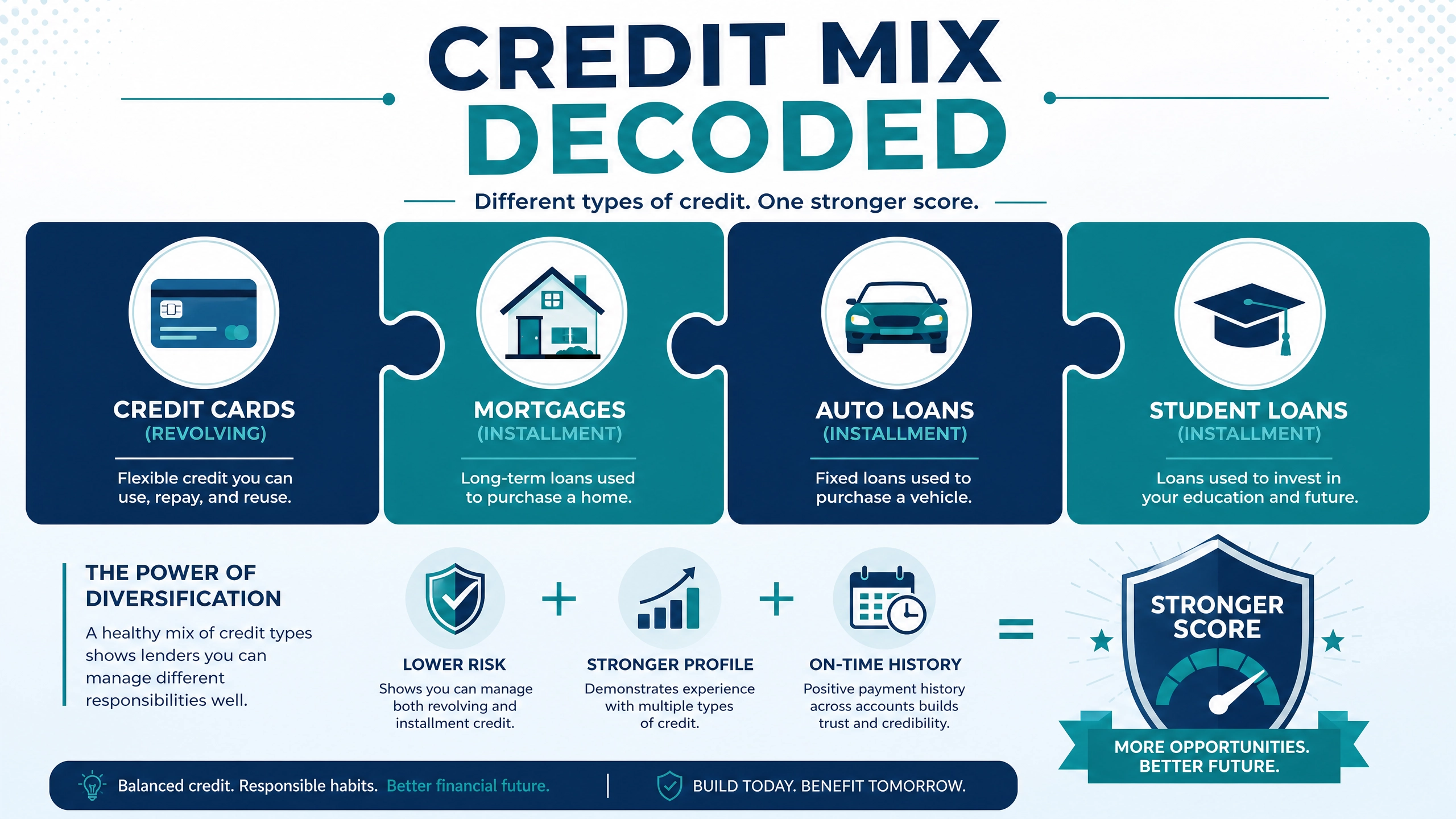
4. Credit Mix (10% of Total Score)
Lenders want to see that you can juggle different types of financial responsibilities simultaneously.
- What it tracks: The diversity of your portfolio. The algorithm categorizes debt into “Revolving Debt” (credit cards) and “Installment Debt” (fixed loans like mortgages or auto loans).
- The Impact: A consumer who flawlessly manages a mortgage, an auto loan, and three credit cards will have a higher score than a consumer who only has three credit cards.
- The Goal: Do not take out loans and pay interest just to improve this category. Simply be aware that a natural, diverse mix of healthy debt slowly boosts your score over time.
5. New Credit / Hard Inquiries (10% of Total Score)
When you apply for a new line of credit, the lender requests your file from the bureaus. This is called a “Hard Inquiry” or “Hard Pull.”
- What it tracks: How many new accounts you have opened recently and how many times you have applied for credit.
- The Impact: Opening five new credit cards in a single month screams financial desperation to the algorithm. Each hard inquiry typically drops your score by a negligible 2 to 5 points, but they compound if you apply excessively. (Hard inquiries fall off your report entirely after two years).
- The Goal: Space out your credit applications. Only apply for new credit when you strategically need it.
3. The Lifecycle of a Credit Report Update
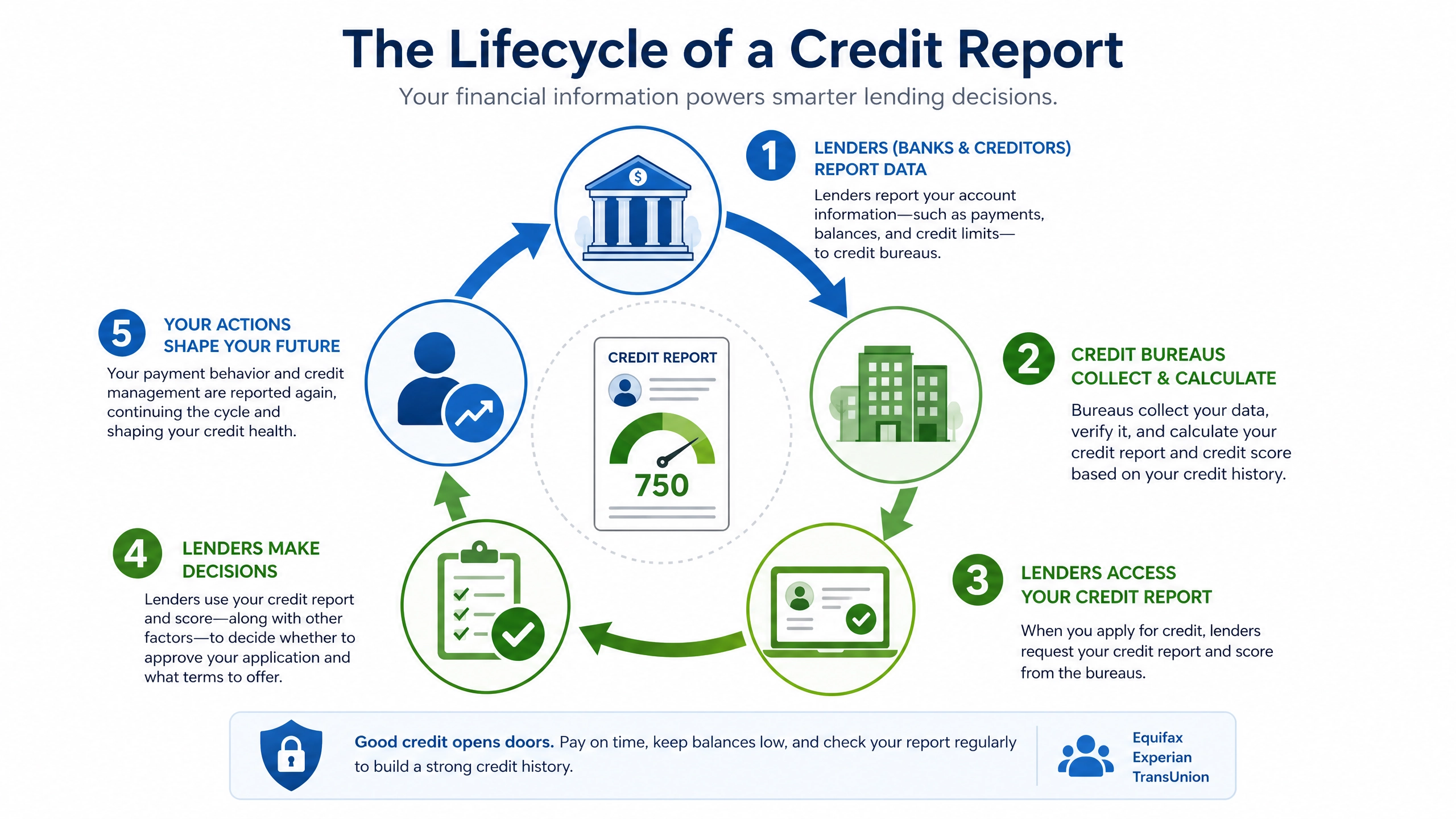
A common source of frustration for consumers is the delay between their actions and their score updating. If you pay off a massive $5,000 credit card debt today, you might log into your banking app tomorrow and see that your score hasn’t moved a single point.
Credit scores do not update in real-time.
The system operates on a batch-reporting cycle. Your credit card issuer (e.g., Chase or American Express) only sends your data to Experian, Equifax, and TransUnion once a month, usually on your statement closing date.
- Example: Your statement closes on the 15th of the month. On the 16th, the bank sends a “snapshot” of your balance and payment status to the bureaus.
- The bureaus receive the data and update your raw credit report.
- The next time you request your score (or an app generates it), the FICO algorithm scans that newly updated report and calculates the fresh number.
If you want to manipulate your score for a mortgage application, you must pay your balances down before the statement closing date, ensuring the snapshot sent to the bureaus reflects a zero or microscopically low balance.
4. Hard Inquiries vs. Soft Inquiries: The Crucial Difference
Understanding who is looking at your credit, and how it impacts your score, is vital for protecting your financial reputation.
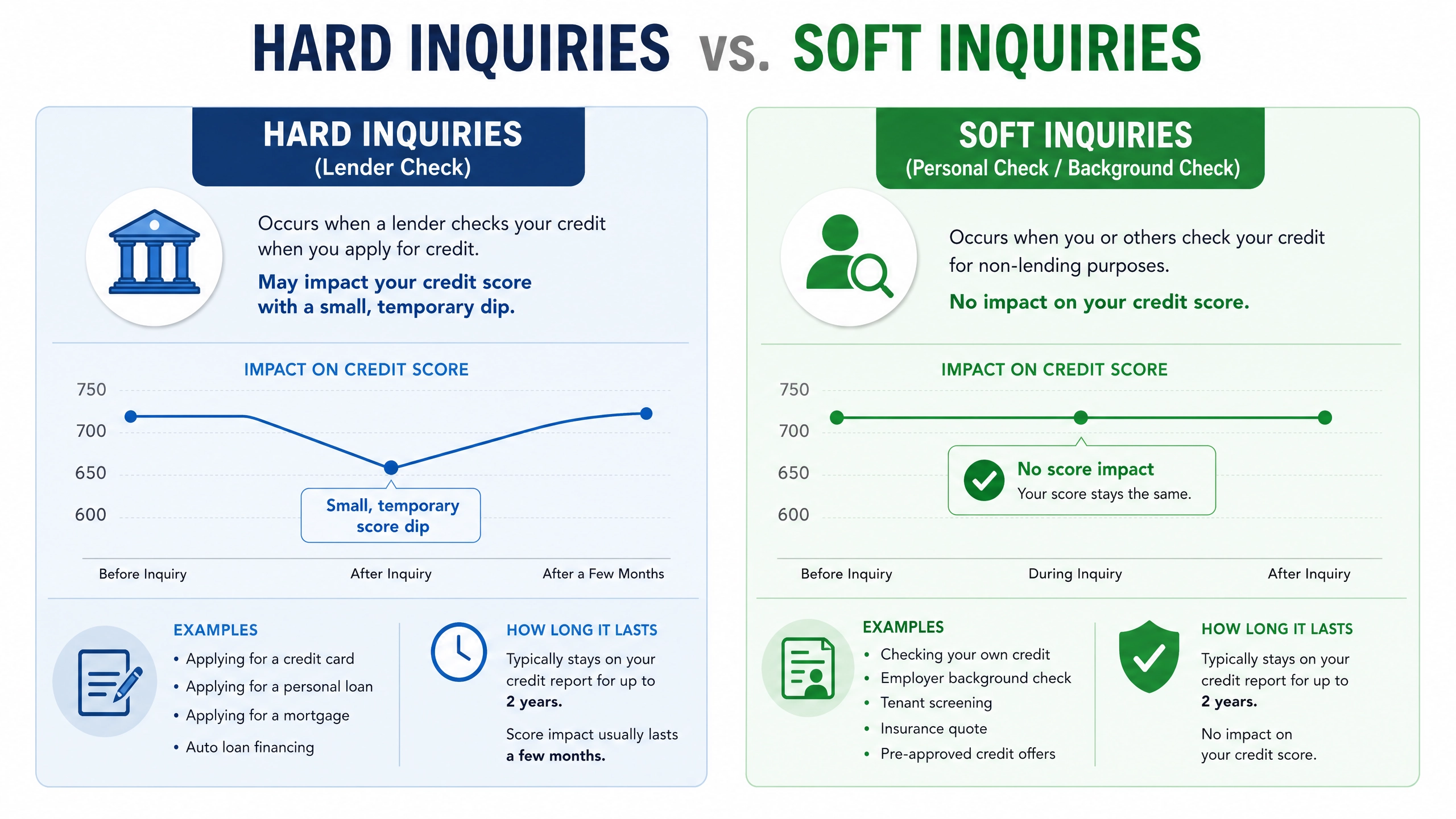
The Hard Inquiry (Impacts Score)
A hard inquiry occurs when you actively apply for new credit and the lender needs to make a firm underwriting decision.
- Triggers: Applying for a mortgage, auto loan, credit card, or personal loan. Requesting a massive credit limit increase can also trigger a hard pull (depending on the bank).
- The Rule: You must explicitly authorize a hard inquiry. A lender cannot perform one without your consent (usually buried in the fine print of the application).
The Soft Inquiry (Zero Impact)
A soft inquiry occurs when a person or company checks your credit file as a background check, or when a lender checks your file to “pre-approve” you for an offer.
- Triggers: Checking your own credit score on an app, an employer doing a background check, a landlord checking your history for a rental application, or credit card companies sending you “pre-approved” junk mail.
- The Rule: Soft inquiries never, ever impact your credit score. You can check your own credit score 500 times a day, and it will not drop a single point.
5. The Devastating Impact of Derogatory Marks
While building good credit takes years of patient consistency, destroying it takes only a moment of negligence. When you fail to uphold your end of a financial contract, lenders report “derogatory marks” to the bureaus. These marks act as toxic anchors on your FICO score.
The 30-Day Late Payment
Banks generally do not report a payment as “late” to the credit bureaus until it is a full 30 days past the due date. If you are 5 days late, you will pay the bank a late fee, but your credit score is safe. Once it hits 30 days, the derogatory mark is filed, your score plummets, and the mark remains on your report for 7 years.
Collections and Charge-Offs
If you ignore a debt for 120 to 180 days, the bank will give up on trying to collect it from you. They will “charge off” the account as a loss and often sell the debt for pennies on the dollar to a third-party collection agency. Both the original charge-off and the new collection account will brutally suppress your score for 7 years.
Bankruptcies
This is the nuclear option of personal finance. Filing for Chapter 7 (liquidation) or Chapter 13 (reorganization) bankruptcy provides legal protection from creditors, but it is the most damaging mark possible on a credit report. A Chapter 7 bankruptcy will remain on your public record and suppress your score for 10 years.
6. How to Dispute Errors on Your Credit Report
Because the credit bureaus process billions of data points a month, massive errors are incredibly common. A study by the FTC found that one in five consumers had a verifiable error on at least one of their credit reports.
You might have a late payment from an account you don’t even own, or a collection account from a medical bill you already paid. If you do not actively police your own report, these errors will cost you money in higher interest rates.
The Dispute Process
By federal law (The Fair Credit Reporting Act), you have the right to challenge the accuracy of any information on your report.
- Pull Your Reports: Go to AnnualCreditReport.com (the only federally authorized site) and download your raw reports from all three bureaus for free.
- Identify the Error: Find the specific account and the incorrect data point (e.g., a 30-day late mark in August 2024 when you have bank statements proving you paid on time).
- File the Dispute: Initiate a formal dispute directly on the bureau’s website (Experian, Equifax, or TransUnion). Upload your supporting documentation.
- The 30-Day Window: By law, the bureau has 30 days to contact the lender and investigate your claim. If the lender cannot verify the negative information within 30 days, the bureau must delete the mark from your report entirely, often resulting in an immediate score increase.

7. Comparative Matrix: Credit Score Tiers and Real-World Impact
A credit score is ultimately a key that unlocks different tiers of the economy. Use this reference matrix to understand where you stand and what it costs you.
| FICO Score Range | Industry Designation | Real-World Financial Impact |
|---|---|---|
| 300 – 579 | Poor (High Risk) | Denied for most traditional credit. Forced to use subprime auto loans (15%+ interest) and secured credit cards. Difficulty renting apartments. |
| 580 – 669 | Fair (Subprime) | Approved for basic credit cards with low limits. Can secure FHA mortgages, but will pay significantly higher interest rates on all loans. |
| 670 – 739 | Good (Prime) | The national average. Easily approved for standard auto loans, mortgages, and mid-tier rewards cards with competitive interest rates. |
| 740 – 799 | Very Good (Premium) | Qualifies for the absolute best mortgage rates on the market. Instant approval for premium travel rewards cards (like Chase Sapphire or Amex Gold). |
| 800 – 850 | Exceptional (Elite) | Total financial leverage. Lenders actively compete for your business. Qualifies for ultra-luxury credit products and zero-percent financing offers. |
8. The “No Credit” Dilemma: How to Establish a Score from Scratch
A massive paradox in the financial system is that you need a credit score to get a credit card, but you need a credit card to build a credit score. If you are an 18-year-old student or a recent immigrant, you have a “thin file,” meaning the FICO algorithm cannot generate a score because there is no data to grade.
To break into the system, you must use specialized tools designed for beginners:
- The Secured Credit Card: You provide a cash deposit (e.g., $300) to the bank, which becomes your credit limit. Because the bank holds your cash as collateral, there is zero risk to them. You use the card for small purchases, pay it off in full every month, and the bank reports your good behavior, establishing your score in about six months.
- Authorized User Status (Piggybacking): Ask a parent or spouse with a flawless credit history to add you as an “Authorized User” on their oldest credit card. You do not need to use the physical card. The entire flawless history of that specific account is instantly copied onto your blank credit report, jumpstarting your score.
9. Frequently Asked Questions (FAQ)
Does my income or bank balance affect my credit score?
Absolutely not. This is a massive myth. Your credit report does not contain any information about your salary, your total net worth, your investment portfolio, or how much cash is in your checking account. You can be a millionaire with a terrible 500 credit score (because you miss payments), or a minimum-wage worker with a perfect 820 credit score (because you manage small amounts of debt flawlessly).
Does carrying a small balance on my credit card build credit faster?
No. This is the most expensive, destructive myth in personal finance. You do not need to pay interest to build credit. Paying your statement balance in full every single month is the absolute best thing you can do for your score. Carrying a balance only enriches the banking institutions at your expense.

Why did my credit score drop after I paid off my auto loan or mortgage?
This is a highly frustrating quirk of the FICO algorithm. When you pay off an installment loan entirely, the account is officially closed. Because it is closed, it alters your “Credit Mix” (you no longer have an active installment loan) and it lowers your total overall available credit. This usually results in a temporary 10-to-20 point drop. However, do not panic; the score will naturally rebound within a few months, and you should celebrate being debt-free regardless of the temporary algorithmic dip.
Author’s Note: Seizing Control of the Algorithm
The credit scoring system can often feel like a dystopian, inescapable surveillance network. Every financial move you make is tracked, categorized, and graded by massive corporations.
However, you must reframe how you view this system. Because the FICO score is based on rigid, transparent mathematical rules, it is entirely predictable. It is not an emotional entity; it is a machine. And like any machine, once you understand how the gears turn, you can learn to operate it to your absolute advantage.
A perfect credit score is not a metric of human morality, nor is it a reflection of your intrinsic worth. It is simply a tool. It is the lever you pull to secure the lowest possible interest rate on a 30-year mortgage, saving your family tens of thousands of dollars over a lifetime. It is the mechanism you use to travel the world in first-class for free using credit card rewards points.
Stop viewing your credit score as a mysterious grade handed down by a judge. View it as a strategic game. Automate your payments, keep your utilization microscopically low, protect your oldest accounts, and watch as the doors of the modern financial system swing wide open for you.