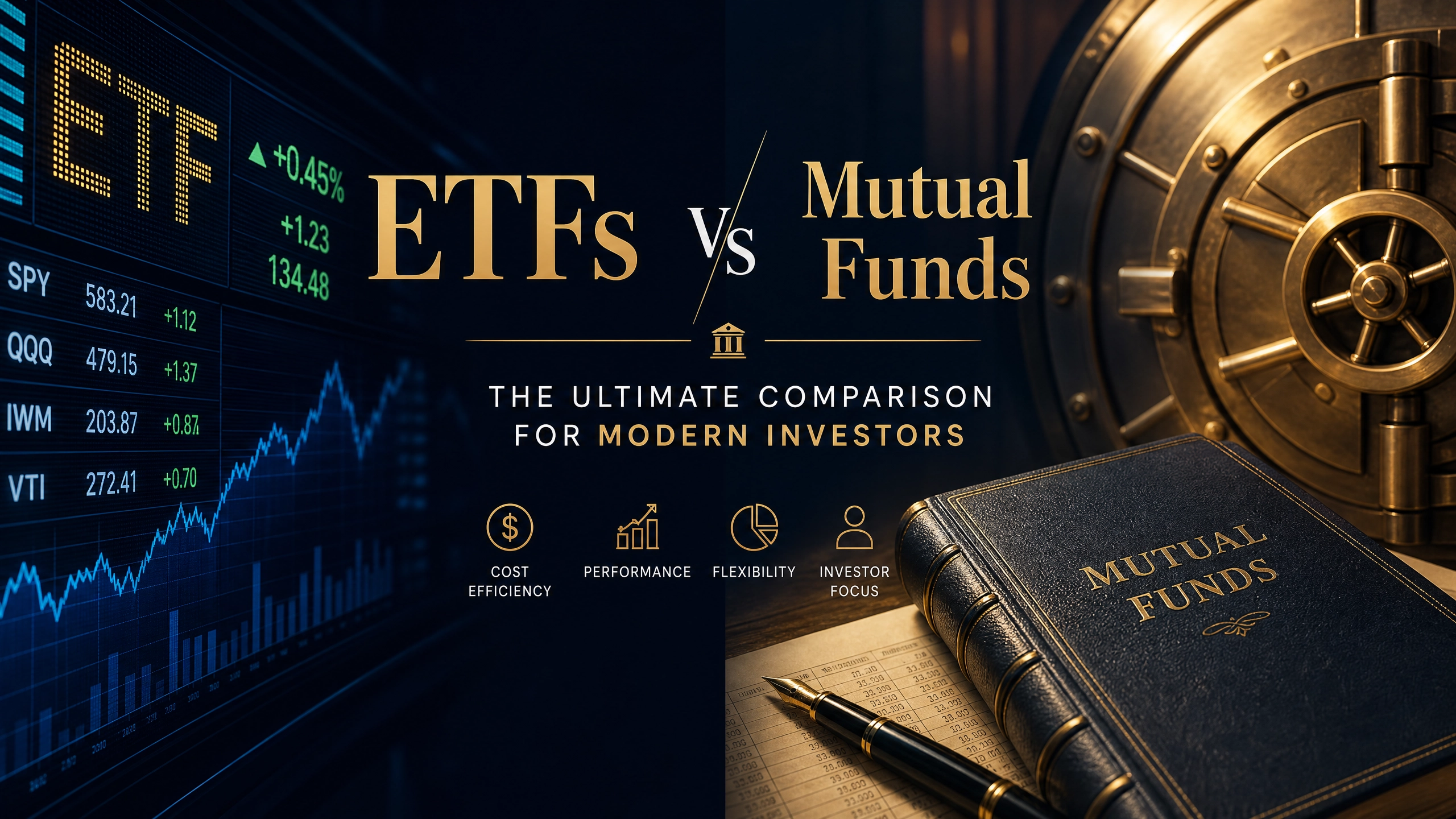
ETFs vs Mutual Funds: The Ultimate Comparison for Modern Investors
When an individual decides to take control of their financial destiny and transition from a saver to an investor, they are immediately confronted by an intimidating wall of Wall Street jargon. Among the most common—and most confusing—decisions a new investor faces is choosing the right vehicle to hold their investments.
You know you need to diversify. You know you shouldn’t put all your money into a single company’s stock. You want to buy a pre-packaged “basket” of hundreds of companies. But when you log into your brokerage account, you are presented with two seemingly identical options for buying that basket: The Mutual Fund and the Exchange-Traded Fund (ETF).
To the untrained eye, they look exactly the same. They often hold the exact same stocks, track the exact same indexes (like the S&P 500), and achieve remarkably similar long-term returns. However, under the hood, their mechanical structure, their tax efficiency, their pricing models, and how they are traded are fundamentally different.
Understanding these mechanical differences is not just an exercise in financial vocabulary; it is a critical step in optimizing your portfolio, minimizing your tax burden, and ensuring your investment vehicle aligns with your trading psychology. This comprehensive guide will dissect ETFs and Mutual Funds, compare their core architectures, demystify their tax implications, and provide a clear framework to help you choose the perfect vehicle for your wealth-building journey.
1. The Core Architectures: How They Work
Before comparing them, you must understand the fundamental engineering behind each investment vehicle. Both are designed to pool money from thousands of investors to buy a massive, diversified portfolio of assets (stocks, bonds, or real estate). The difference lies in how you enter and exit that pool.
The Mutual Fund: The Traditional Behemoth
Mutual funds have been the foundational bedrock of retirement accounts (like 401(k)s) for nearly a century.
- The Structure: When you invest in a mutual fund, you are transacting directly with the fund company itself (e.g., Vanguard or Fidelity).
- The Mechanism: If you want to invest $1,000, you send that money to the fund manager. The manager takes your cash, goes out into the stock market, buys more shares of the underlying companies, and issues you new “shares” of the mutual fund. When you want to sell, the fund manager literally liquidates a tiny piece of the portfolio and hands you cash.
- Active vs. Passive: Historically, most mutual funds were “Actively Managed,” meaning a highly paid Wall Street analyst picked specific stocks trying to beat the market. Today, “Passive” Index Mutual Funds (which just use an algorithm to track the market) are incredibly popular.
The Exchange-Traded Fund (ETF): The Modern Evolution
ETFs were introduced in the early 1990s as a faster, more flexible alternative to the mutual fund.
- The Structure: An ETF is structured exactly like a standard, individual stock (like Apple or Tesla).
- The Mechanism: When you buy a share of an ETF, you are not sending your money to Vanguard or BlackRock. You are buying an existing share from another investor on the open stock exchange. The total number of ETF shares remains relatively constant during normal daily trading; they simply change hands between buyers and sellers.
- Active vs. Passive: While active ETFs exist, the vast majority of ETFs are “Passive” index trackers.
2. Trading Mechanics and Pricing (The Time Factor)
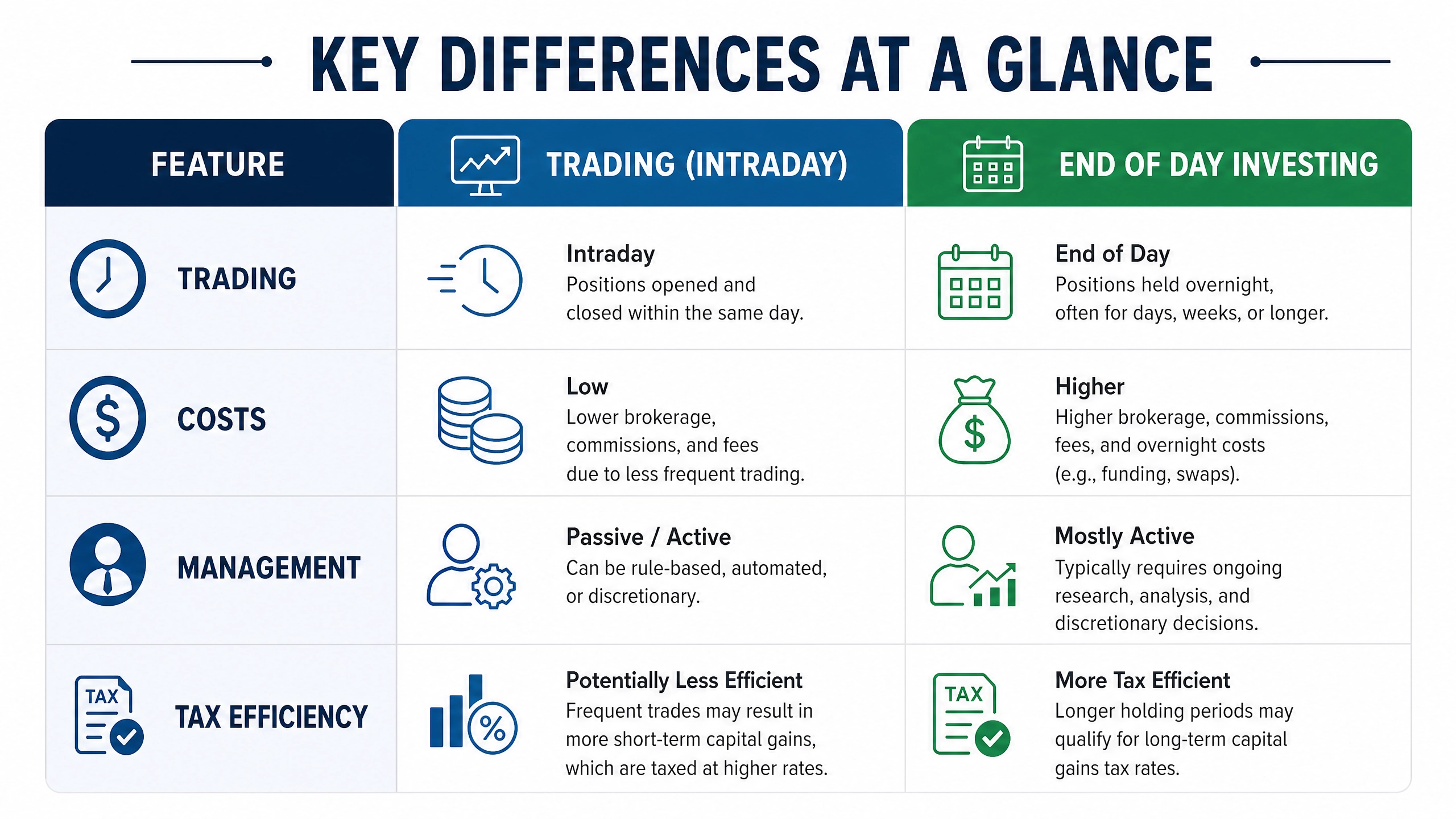
The most immediately obvious difference to a retail investor is how and when the transactions actually execute.
Mutual Funds: The End-of-Day Settlement
Mutual funds are not built for speed; they are built for steady accumulation.
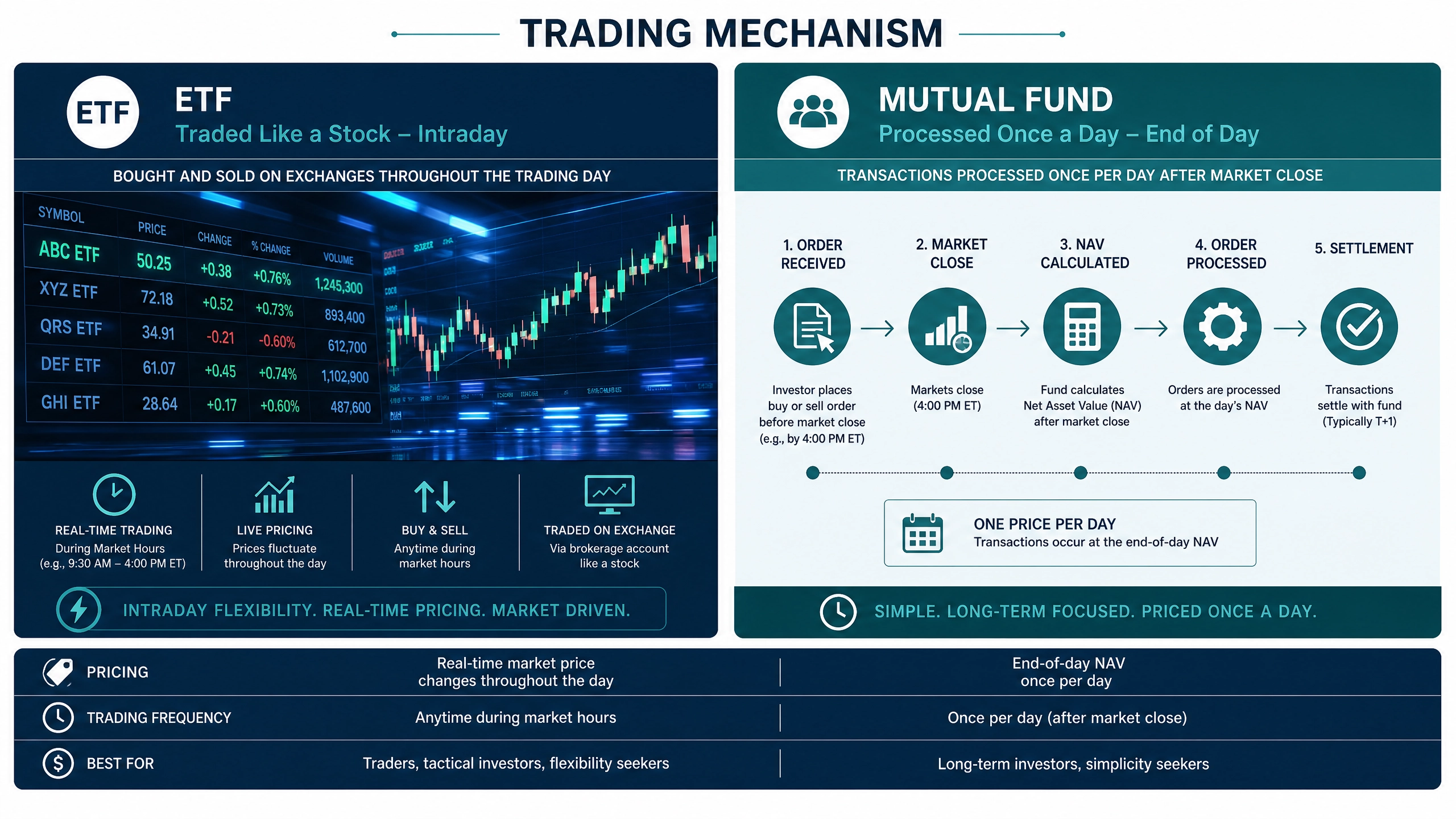
- Net Asset Value (NAV): A mutual fund’s price is calculated only once per day, at 4:00 PM Eastern Time (when the stock market closes). This price is called the Net Asset Value (NAV). It is calculated by taking the total value of all the stocks in the basket and dividing it by the total number of fund shares.
- Execution: If you place an order to buy a mutual fund at 10:00 AM on a Tuesday, you do not know exactly what price you will pay. Your order sits in a queue all day. At 4:00 PM, the closing NAV is calculated, and your order executes at that final, single price.
ETFs: Real-Time Trading
ETFs are designed for absolute fluidity and immediate execution.
- Market Pricing: Because ETFs trade on public stock exchanges, their price fluctuates by the second throughout the entire trading day based on live supply and demand.
- Execution: If you place an order to buy an ETF at 10:15 AM, the transaction executes instantaneously at the live market price at that exact millisecond.
- Advanced Orders: Because they trade like stocks, you can use advanced trading mechanics with ETFs, such as “Limit Orders” (specifying the exact maximum price you are willing to pay) or “Stop-Loss Orders” (automatically selling if the price drops to a certain level). You cannot do this with mutual funds.
3. Minimum Investments: The Barrier to Entry
Historically, the amount of cash you had in your bank account dictated which vehicle you were allowed to use.
The Mutual Fund Barrier
Mutual funds traditionally required a massive upfront cash deposit just to open the account. This was designed to deter frequent, small-dollar trading, which creates administrative headaches for the fund manager.
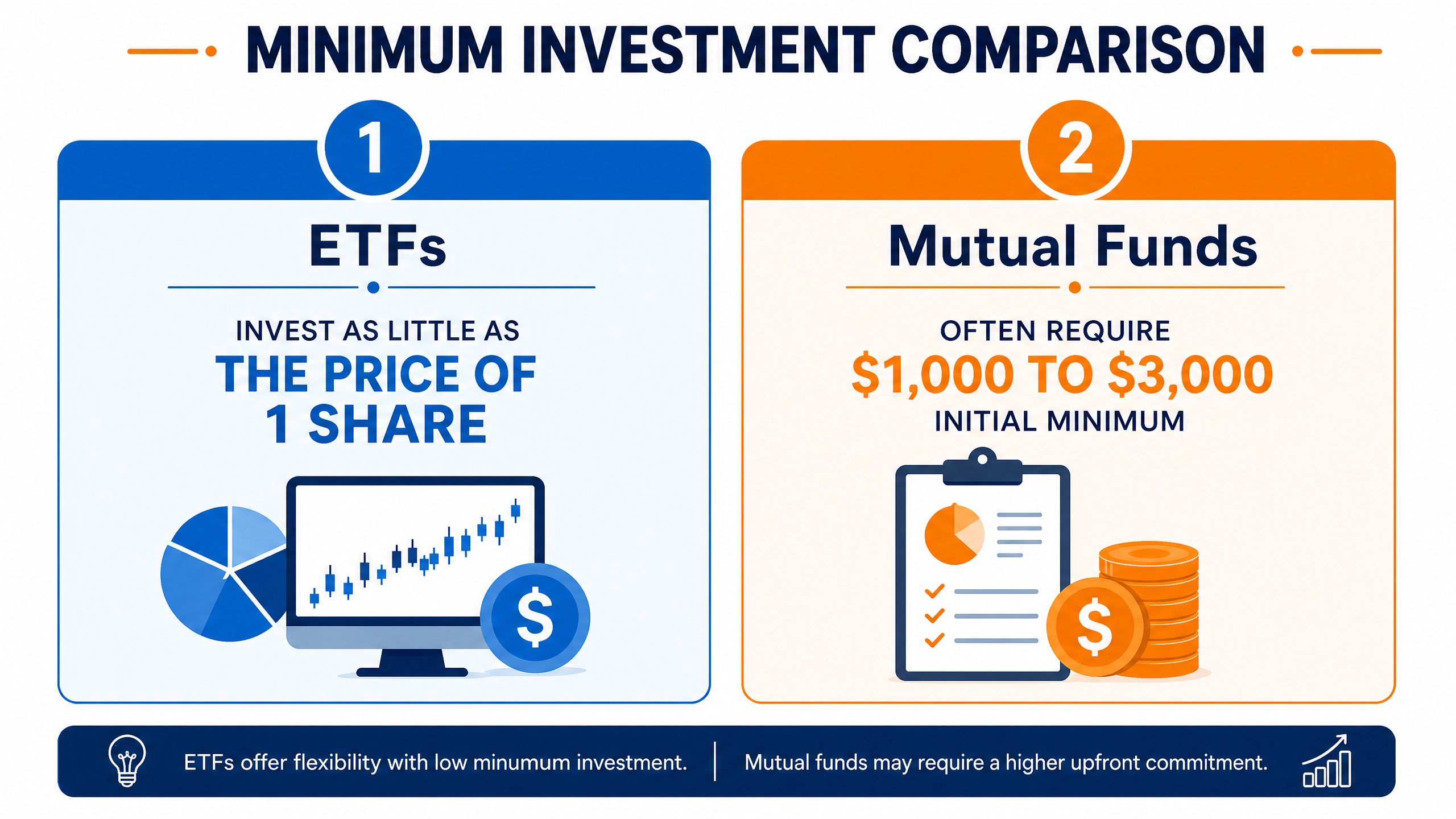
- The Status Quo: It was common for a premium mutual fund (like the Vanguard Total Stock Market Index Fund, VTSAX) to require a $3,000 minimum initial investment. Once you crossed that initial threshold, you could invest smaller amounts (like $50 a month).
- Note: In recent years, intense competition has forced many brokerages (like Fidelity and Charles Schwab) to drop their mutual fund minimums to $0, though Vanguard still maintains minimums on many of its flagship funds.
The ETF Accessibility
ETFs democratized investing for individuals with very little starting capital.
- The Barrier: There is no minimum investment requirement for an ETF. Your only barrier to entry is the price of a single share. If an S&P 500 ETF (like VOO) is trading at $450, you only need $450 to start investing.
- Fractional Shares: Modern financial technology has made ETFs even more accessible. Today, almost all major brokerages allow you to buy “fractional shares.” This means you can literally invest exactly $10 into a $450 ETF, and the computer will assign you a micro-fraction of a share.
4. The Tax Efficiency Showdown (Capital Gains)
If you are investing inside a tax-sheltered retirement account (like a Roth IRA or a 401(k)), you can entirely skip this section, as taxes do not apply to transactions within those accounts.
However, if you are investing in a standard, taxable brokerage account, the mechanical differences between ETFs and mutual funds have massive, real-world tax implications. In a taxable account, ETFs are structurally vastly superior.
The Mutual Fund Tax Trap
When you own a mutual fund, you are sharing the tax burden with every other investor in that massive pool.
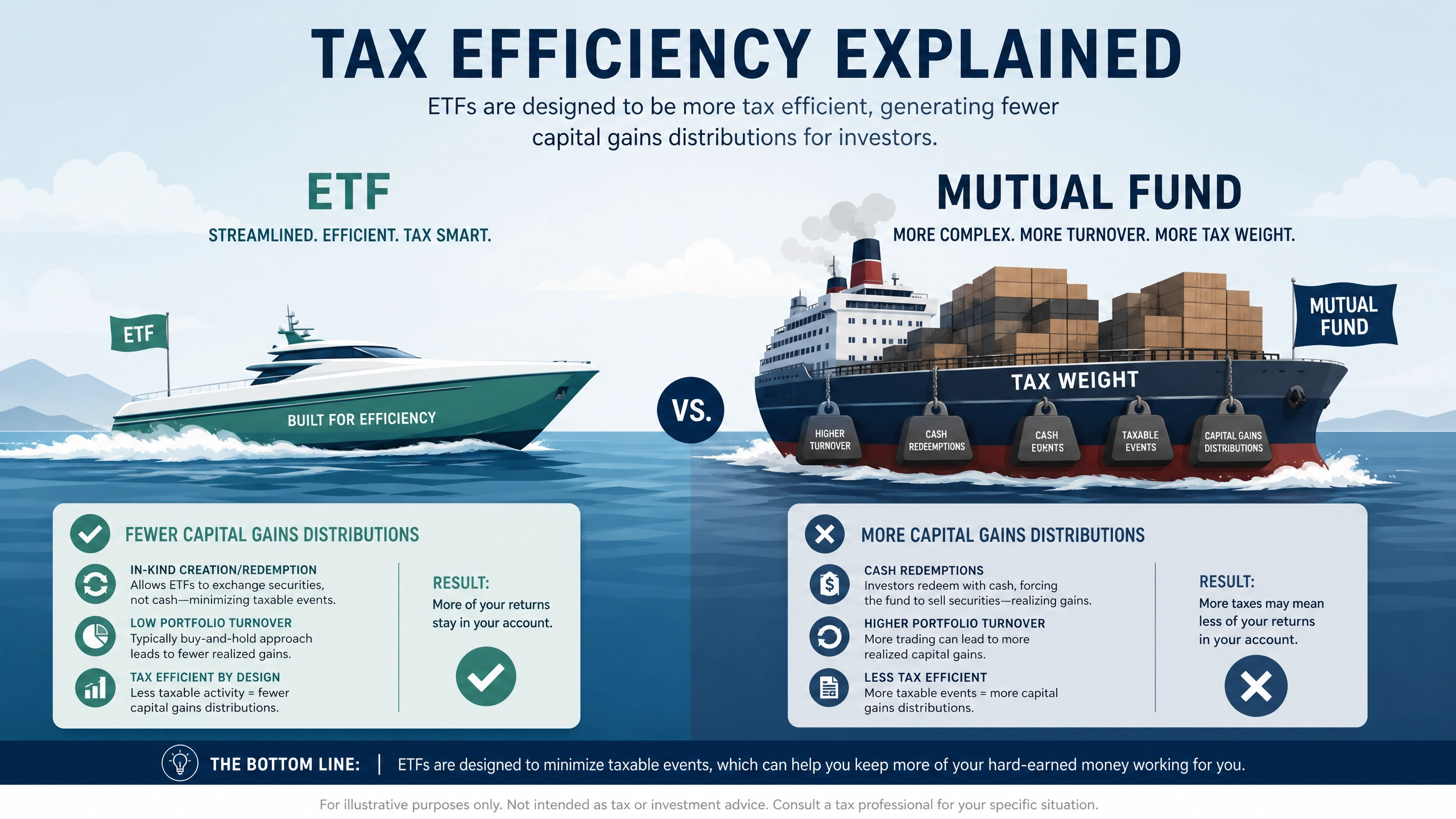
When investors panic and decide to sell their mutual fund shares, the fund manager must raise cash to pay them. To raise cash, the manager must sell off some of the profitable stocks inside the fund. This creates a “Capital Gain.” By law, the mutual fund must pass those capital gains taxes onto all shareholders at the end of the year.
The Result: You could buy a mutual fund, hold it perfectly still, not sell a single share, and still receive a surprise tax bill at the end of the year simply because other investors in the fund decided to sell.
The ETF Tax Shield
ETFs possess a brilliant structural loophole known as the “In-Kind Creation and Redemption” process.
Because ETF shares are traded between individual investors on the open market, the ETF manager rarely has to sell the underlying stocks to raise cash. If an investor wants to sell, they just sell their ETF share to another buyer on the exchange. The stocks inside the ETF basket remain untouched.
Therefore, ETFs rarely generate internal capital gains. You generally only pay capital gains taxes when you personally decide to sell your ETF shares for a profit. You have total control over your tax timeline.
5. Fees and Expense Ratios
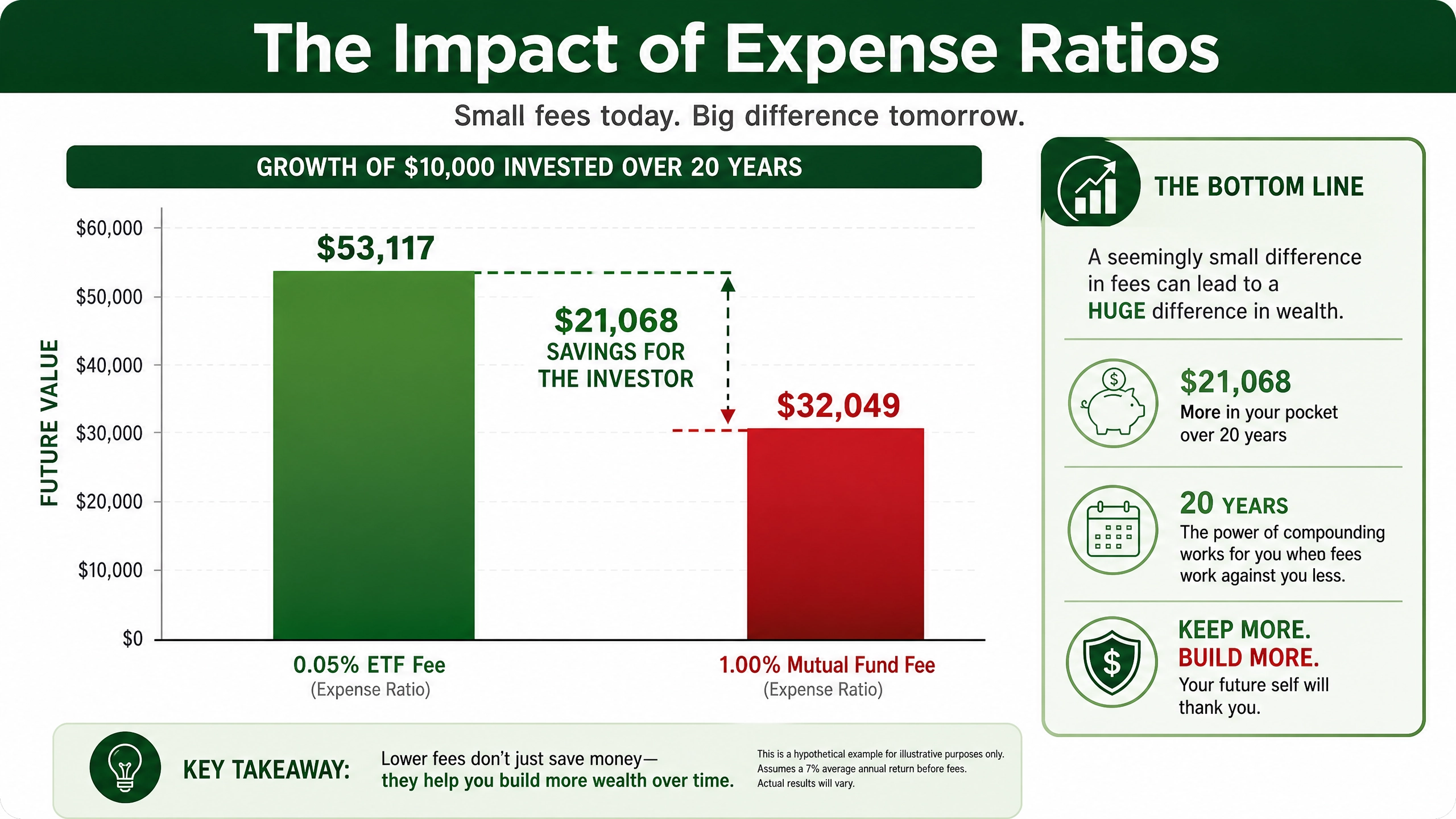
The single greatest predictor of your long-term investment success is keeping your fees as low as humanly possible. The fee charged by both mutual funds and ETFs to manage the portfolio is called the Expense Ratio.
- The Modern Landscape: Today, if you are comparing an Index ETF to an Index Mutual Fund that tracks the exact same thing (e.g., the Vanguard S&P 500 ETF vs. the Vanguard S&P 500 Mutual Fund), the expense ratios are practically identical. Both will charge microscopic fees, usually around 0.03% to 0.04% annually.
- The Active Fund Warning: The real danger lies in Actively Managed Mutual Funds. These funds employ expensive human managers who attempt to pick winning stocks. They routinely charge exorbitant expense ratios of 1.00% to 1.50%. Over a 30-year investing horizon, a 1.5% fee can devour hundreds of thousands of dollars of your potential compound growth. You must relentlessly avoid high-fee active mutual funds.
6. Automation: The Ultimate Behavioral Advantage
While ETFs win the tax battle, Mutual Funds hold a massive psychological and mechanical advantage when it comes to long-term wealth building: Total Automation.
The Mutual Fund Autopilot
Because mutual funds allow you to invest by fixed dollar amounts (rather than whole shares), they are perfectly engineered for “set it and forget it” investing.
You can instruct your brokerage: “Pull exactly $500 from my checking account on the 1st of every month and buy this mutual fund.” The system will automatically execute this regardless of what the share price is that day. You remove human emotion, willpower, and the temptation to “time the market” entirely from the equation.
The ETF Friction
Historically, you could not automate ETF purchases. Because ETF prices fluctuate by the second, and because you had to buy whole shares, you had to manually log in, calculate how many shares you could afford with your $500, and execute the trade yourself. This manual process introduces friction, and friction often leads to skipped months and emotional trading.
The Modern Shift: It is crucial to note that modern brokerages (like Robinhood, M1 Finance, and increasingly Fidelity) have finally built software that allows for automated, fractional ETF investing, slowly erasing this historical mutual fund advantage. However, at legacy institutions, mutual funds still offer superior, seamless automation.
7. Comparative Matrix: ETF vs. Mutual Fund
Use this reference table to instantly compare the structural realities of both vehicles.
| Feature | Exchange-Traded Fund (ETF) | Traditional Mutual Fund |
|---|---|---|
| Trading Mechanics | Real-time during market hours. | Once daily at the 4:00 PM closing NAV. |
| Pricing | Fluctuates by the millisecond. | Set once per day. |
| Minimum Investment | Price of 1 share (or $1 fractional). | Can range from $0 to $3,000+. |
| Tax Efficiency (Taxable Accounts) | Exceptionally High (Rarely distributes surprise capital gains). | Lower (Can distribute surprise capital gains due to other investors selling). |
| Automatic Investing (Auto-Pay) | Historically difficult (improving on modern apps). | Flawless (Perfect for automated monthly dollar-cost averaging). |
| Advanced Order Types | Yes (Limit orders, stop-losses). | No (Market orders only). |
| Ticker Symbol Format | Usually 3 to 4 letters (e.g., VOO, SPY). | Usually 5 letters ending in ‘X’ (e.g., VFIAX, FXAIX). |

8. Strategy: Which Vehicle Should You Choose?
The decision between an ETF and a mutual fund ultimately depends entirely on where you are putting the money and how you plan to manage it.
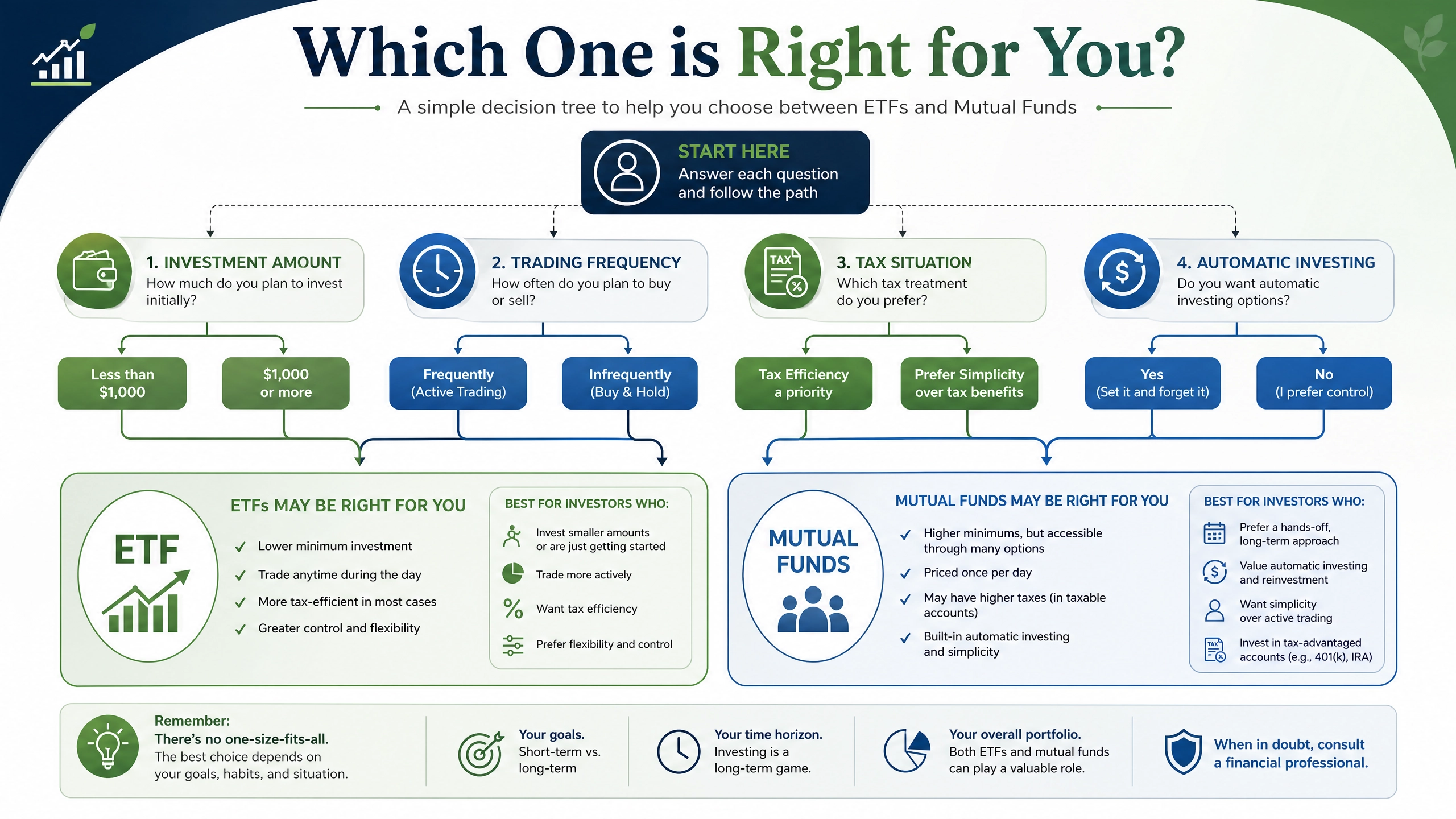
Scenario A: The Taxable Brokerage Account
- The Winner: The ETF.
- The Reason: If you are investing outside of a retirement account (meaning the IRS is watching your every move), the tax efficiency of the ETF is paramount. You must shield yourself from the surprise capital gains distributions that plague mutual funds.
Scenario B: The Retirement Account (Roth IRA or 401k)
- The Winner: It is a tie, but Mutual Funds often hold a slight edge.
- The Reason: Inside a Roth IRA or a 401(k), taxes do not matter; you are completely shielded from capital gains. Therefore, the ETF’s main superpower is irrelevant. In this scenario, the flawless automation and ability to invest exact dollar amounts (down to the penny) make the Index Mutual Fund the ultimate “set it and forget it” tool for decades of effortless accumulation.
Scenario C: The Active Trader
- The Winner: The ETF.
- The Reason: If you are (unwisely) attempting to time the market, day trade, or need to liquidate your assets at 11:30 AM in response to a breaking news alert, the real-time execution and advanced order types of the ETF are mandatory. Mutual funds are useless for active trading.
9. Frequently Asked Questions (FAQ)
Can an ETF and a Mutual Fund hold the exact same stocks?
Yes, absolutely. For example, Vanguard offers the Vanguard S&P 500 ETF (Ticker: VOO) and the Vanguard 500 Index Fund Admiral Shares (Ticker: VFIAX). They both hold the exact same 500 largest US companies in the exact same proportions. Their performance over a decade will be virtually identical. The only difference is the “wrapper” (how they trade and how they are taxed).
Are ETFs riskier than Mutual Funds?
No. The risk level is determined entirely by what is inside the basket, not the vehicle itself. A mutual fund that holds highly volatile biotech startup stocks is infinitely riskier than an ETF that holds stable US Government Treasury bonds.
Can I convert my Mutual Fund into an ETF?
This depends on the brokerage. Vanguard actually holds a patent that allows its investors to convert their Vanguard index mutual funds into the equivalent Vanguard ETF version completely tax-free. However, this is a one-way street; you generally cannot convert an ETF back into a mutual fund. If you hold funds at other brokerages, you usually have to sell the mutual fund (triggering taxes) to buy the ETF.
What are Target Date Funds?
Target Date Funds (like a “2055 Retirement Fund”) are almost exclusively structured as Mutual Funds. They are “fund of funds” that automatically rebalance your asset allocation (shifting from aggressive stocks to conservative bonds) as you get closer to your retirement year. They are the ultimate automated retirement vehicle, designed for 401(k) plans.
Author’s Note: The Illusion of Complexity
The financial services industry thrives on complexity. By creating a dizzying array of acronyms, fund structures, and specialized investment vehicles, they convince the average consumer that investing is a dark art that requires an expensive professional guide.
The debate between ETFs and Mutual Funds is a perfect example of this manufactured complexity. While the mechanical and tax differences are important for optimization, they are ultimately secondary to the primary directive of wealth building.
Do not let the “ETF vs. Mutual Fund” debate paralyze you. The absolute worst decision you can make is to leave your cash rotting in a low-interest checking account because you were afraid of choosing the wrong acronym.
Whether you choose a low-cost S&P 500 ETF or a low-cost S&P 500 Index Mutual Fund, you are buying the exact same phenomenal engine of global capitalism. The most important metric is not the vehicle you choose; it is your savings rate and your consistency. Choose the vehicle that fits your account type, automate your monthly contributions, ignore the daily fluctuations of the market, and let time execute the heavy lifting of generational wealth creation.