The Ultimate Guide to Dividend Investing: Generating Passive Income for Life
When most individuals think about investing in the stock market, they envision a singular path to wealth: “Buy low, sell high.” This traditional strategy relies entirely on capital appreciation—hoping that a stock you buy today for $50 will eventually be worth $100 so you can sell it for a profit. However, this approach carries a glaring flaw: you only realize your wealth when you sell the asset. If the market crashes right when you need the money, you are forced to sell your shares at a massive loss.
But what if there was a way to generate a relentless, growing stream of cash from your investments without ever having to click the “sell” button? What if you could build a portfolio that physically pays you just for owning it?
Welcome to the world of Dividend Investing.
Dividend investing is the pursuit of true, frictionless passive income. It is the strategy utilized by the world’s wealthiest families and legendary investors like Warren Buffett to generate billions of dollars in cash flow, independent of whether the stock market is booming or crashing. This comprehensive guide will demystify the mechanics of dividends, explain the profound mathematical power of reinvestment, outline how to identify elite dividend-paying companies, and provide a clear roadmap to building a portfolio that pays your living expenses for the rest of your life.
1. The Core Mechanics: What Exactly is a Dividend?
To understand dividend investing, you must first understand the fundamental lifecycle of a corporate profit.
When you buy a share of a publicly traded company (like Coca-Cola, Apple, or Johnson & Johnson), you are not just buying a digital ticker symbol; you are buying a fractional ownership stake in a real, functioning business.
When that business sells its products and pays its employees, it is left with net cash profits. The company’s Board of Directors has two primary choices regarding what to do with that massive pile of cash:
- Reinvest for Growth: They can use the cash to build new factories, hire more engineers, or acquire competing companies (This is typical for young tech companies like Tesla or Amazon, which rarely pay dividends).
- Distribute to Shareholders: If the company is massive, mature, and generates more cash than it knows how to effectively spend on expansion, it will take a portion of those profits and distribute them directly into the bank accounts of its shareholders.
This cash distribution is called a Dividend.
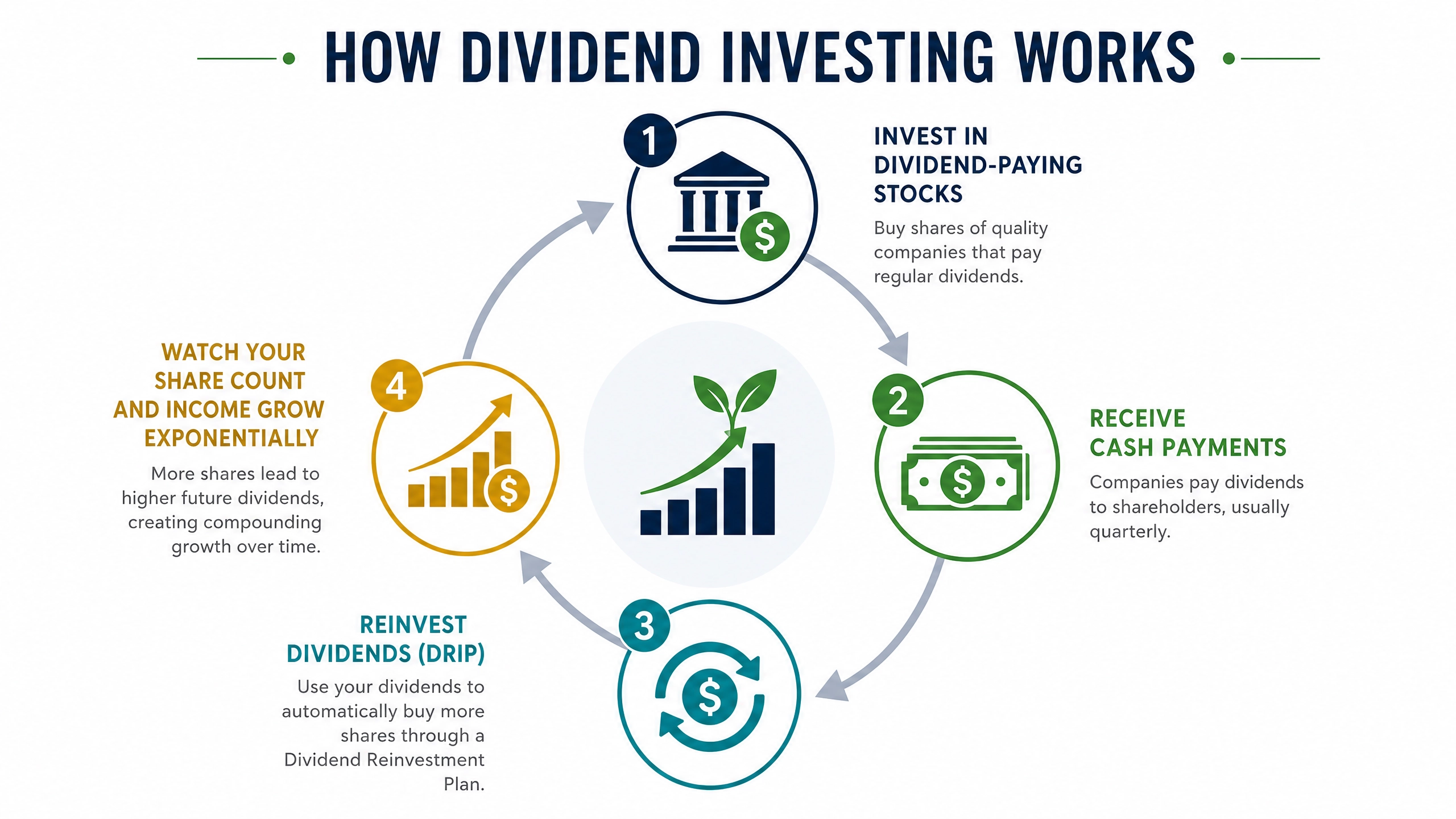
Most major U.S. companies pay dividends on a quarterly basis (four times a year). If a company declares an annual dividend of $4.00 per share, and you own 1,000 shares, you will receive a $1,000 cash deposit into your brokerage account every three months. You do not have to sell a single share to receive this money; it is your legal right as a part-owner of the business.
2. The Golden Metrics of Dividend Investing
You cannot simply buy any stock that pays a dividend and expect to build wealth. You must learn to analyze a company’s dividend health using a few critical financial metrics.
1. Dividend Yield (The Immediate Return)
The dividend yield is the percentage return you receive on your investment through cash payments alone over one year.
- Formula: (Annual Dividend per Share / Current Stock Price) = Dividend Yield.
- Example: If AT&T pays $1.11 per share annually, and the stock is trading at $15.00, the yield is 7.4%.
- The Trap: Novice investors often chase the highest yield possible (e.g., 10% or 12%). A massive yield is often a massive red flag. It usually means the stock price has recently plummeted because the company is in severe financial distress, and a dividend cut is imminent.
2. Payout Ratio (The Safety Net)
This is arguably the most important metric for a dividend investor. The payout ratio tells you exactly how much of a company’s total profit is being used to pay the dividend.
- Formula: (Total Dividends Paid / Total Net Income) = Payout Ratio.
- The Target: A healthy payout ratio generally sits between 40% and 60%. This means the company is generously rewarding shareholders, but still keeping enough cash to handle emergencies or fund future growth. If a payout ratio is over 90% (or over 100%), the dividend is unsustainable and highly vulnerable to being slashed during a recession.
3. Dividend Growth Rate (The Inflation Shield)
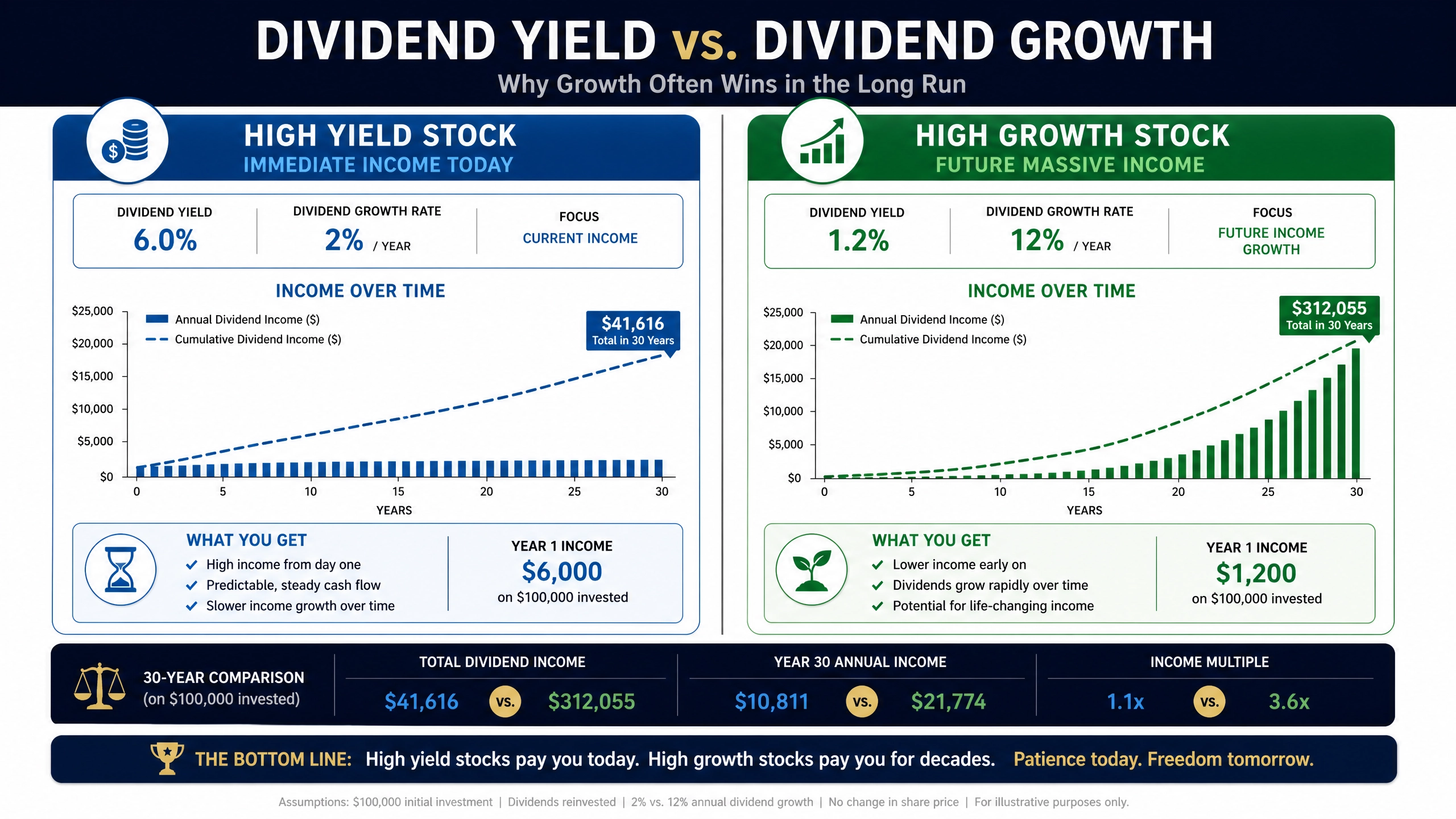
A static dividend is dangerous because its purchasing power will be eroded by inflation over time. You want to invest in companies that increase their dividend payouts every single year. The rate at which they raise that payout is the Dividend Growth Rate. A company that raises its dividend by 7% annually will double your passive income every ten years, completely outpacing standard inflation.
4. The Royalty of the Market: Aristocrats and Kings
In the world of dividend investing, consistency is infinitely more valuable than a high starting yield. The ultimate goal is to find companies that have proven their ability to generate cash and pay shareholders through world wars, economic depressions, dot-com bubbles, and global pandemics.
The financial industry categorizes these elite companies into two specific groups:
The Dividend Aristocrats
To become a Dividend Aristocrat, a company must meet incredibly strict criteria:
- It must be a member of the S&P 500 Index.
- It must meet certain minimum size and liquidity requirements.
- Crucially: It must have increased its base dividend payout every single consecutive year for at least 25 years.
- Examples: McDonald’s, Chevron, Walmart.
The Dividend Kings
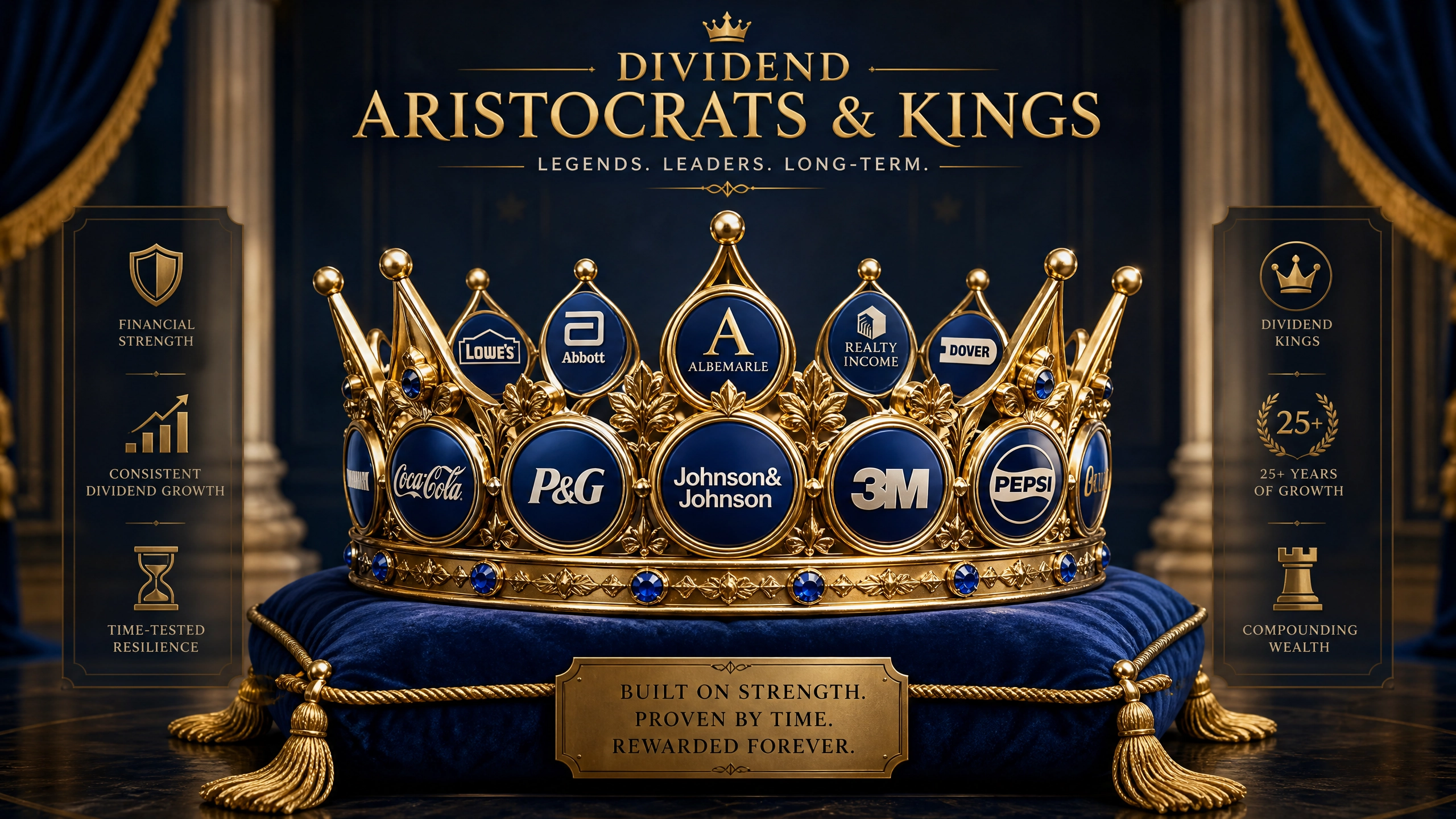
This is the most exclusive club in global finance. To be crowned a Dividend King, a company must have raised its dividend payout every single consecutive year for a staggering 50 years or more.
- Examples: Coca-Cola, Johnson & Johnson, Procter & Gamble.
Investing heavily in Aristocrats and Kings provides a psychological fortress. When the stock market crashes by 20%, the share prices of these companies will drop, but history proves they are highly likely to continue sending you your cash dividend regardless of the market panic.
5. The Magic of DRIP: The Ultimate Wealth Engine
Earning a cash dividend is satisfying, but the true explosive power of dividend investing is unlocked through a process called DRIP (Dividend Reinvestment Plan).
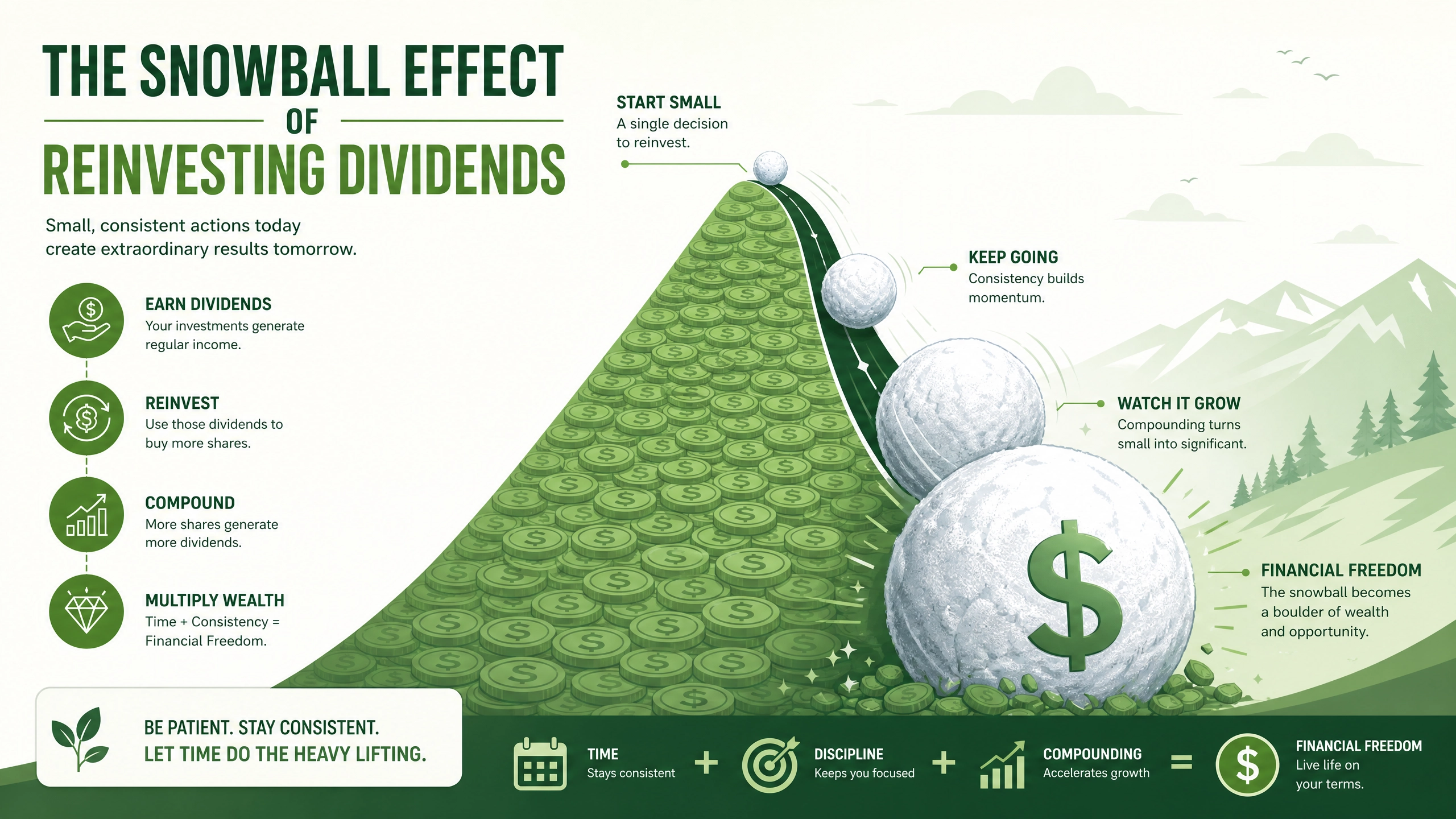
If you take your quarterly dividend cash and spend it on coffee or new shoes, your portfolio will grow at a standard, linear rate. However, if you instruct your brokerage to automatically use that cash to buy more shares of the stock that just paid you, you trigger a massive compound interest snowball.
How DRIP Creates Exponential Wealth
Let’s trace the lifecycle of a DRIP strategy:
- You own 100 shares of a stock.
- The stock pays a dividend.
- The DRIP system automatically uses that cash to buy 2 new shares.
- You now own 102 shares.
- Next quarter, you receive a larger dividend payment because you are being paid on 102 shares instead of 100.
- That larger payment buys you 2.1 new shares. You now own 104.1 shares.
Over 20 or 30 years, this automated cycle of reinvestment causes your share count to explode exponentially. You are acquiring thousands of new shares without ever depositing another penny of your own capital. When you finally reach retirement and turn the DRIP system off, the massive mountain of shares you accumulated will generate a staggering monthly cash flow.
6. How to Build a Dividend Portfolio: Stocks vs. ETFs
When deciding how to execute a dividend strategy, you face the classic investor dilemma: do you pick individual companies or buy a massive basket?
The Individual Stock Approach
Building a portfolio of 20 to 30 individual dividend-paying stocks allows you to target specific, high-yield Aristocrats and manage your exact exposure to different sectors (e.g., Healthcare, Consumer Staples, Utilities).
- The Pros: Complete control, no management fees (expense ratios), and the potential to find undervalued gems.
- The Cons: Requires significant research, quarterly earnings monitoring, and carries the risk of a single company cutting its dividend (which causes the stock price to plummet).
The Dividend ETF Approach (The Effortless Route)
If you do not want to read corporate balance sheets, you can utilize Dividend Exchange-Traded Funds (ETFs). These are single ticker symbols you can buy on the stock market that automatically hold hundreds of the best dividend-paying companies in the world.
- Popular Examples:
- SCHD (Schwab US Dividend Equity ETF): Focuses on high-quality companies with strong financial health and consistent dividend histories.
- VYM (Vanguard High Dividend Yield ETF): A massive basket of over 400 stocks that offer higher-than-average dividend yields.
- NOBL (ProShares S&P 500 Dividend Aristocrats ETF): Exclusively holds only the Dividend Aristocrats.
- The Verdict: For 90% of retail investors, a low-cost dividend ETF is the vastly superior choice. It provides instant, massive diversification and automatic rebalancing, completely eliminating single-stock risk.
7. The Tax Implications of Dividends
In the eyes of the government, dividends are a form of income, and therefore, they are subject to taxation. How you are taxed depends heavily on where the stock is held and what type of dividend it is.
Ordinary vs. Qualified Dividends
If you hold dividend stocks in a standard, taxable brokerage account, the IRS categorizes the payments into two buckets:
- Ordinary Dividends: These are taxed at your standard, ordinary income tax bracket (which can be as high as 37%). This usually applies to real estate (REITs) or stocks you have held for a very short period.
- Qualified Dividends: The government rewards long-term investors. If a U.S. corporation pays the dividend and you have held the stock for more than 60 days, it is considered “Qualified.” Qualified dividends are taxed at the much lower Capital Gains rate (usually 0%, 15%, or 20%, depending on your income).
The Tax-Advantaged Strategy
The ultimate strategy for dividend investors is to hold these assets inside a Roth IRA. If you build your dividend portfolio inside a Roth IRA, you pay absolutely zero taxes on the dividends you receive while the account is growing, and you pay zero taxes when you withdraw that cash flow in retirement. It is the ultimate legal tax shelter for passive income.
8. Comparative Matrix: Dividend Investing vs. Growth Investing
Use this matrix to understand how a dividend-focused strategy differs mechanically and psychologically from a traditional growth-focused strategy (like investing in tech startups).
| Feature | Dividend Investing Strategy | Growth Investing Strategy |
|---|---|---|
| Primary Goal | Generating reliable, growing passive cash flow. | Maximizing the share price for long-term capital appreciation. |
| Typical Companies | Mature, massive, established companies (Consumer Staples, Utilities). | Young, aggressive, expanding companies (Tech, Biotech, AI). |
| Market Crash Psychology | Defensive. The share price drops, but the cash dividends usually continue flowing. | Highly Volatile. The share price drops, and you receive no income to offset the pain. |
| Tax Efficiency | Lower. You are taxed annually on the cash dividends (in taxable accounts). | Higher. You only pay taxes when you eventually sell the stock. |
| Risk Profile | Low to Moderate. | High to Very High. |
9. Frequently Asked Questions (FAQ)
What is the “Ex-Dividend Date”?
This is a critical date for dividend investors. It is the cutoff day. If you want to receive the upcoming dividend payment, you must purchase the stock before the ex-dividend date. If you buy the stock on or after this date, the previous owner gets the current dividend, and you will have to wait until the next quarter to receive your first payment.
Why do some stocks pay massive 12% to 15% dividends?
These are known as “Yield Traps.” A dividend yield is a fraction (Dividend / Stock Price). If a company is failing and its stock price crashes from $100 down to $20, the mathematical yield will suddenly look massive. However, that company is likely bleeding cash and will announce a complete cut of the dividend within weeks. Never chase exceptionally high yields without investigating the underlying payout ratio and financial health.
What are REITs, and are they good for dividends?
A REIT (Real Estate Investment Trust) is a specialized company that owns and operates income-producing real estate (like apartment buildings, hospitals, or data centers). By law, REITs are required to pay out at least 90% of their taxable income to shareholders as dividends. Because of this rule, REITs generally offer much higher yields than standard stocks, making them incredibly popular for passive income portfolios. (Note: REIT dividends are usually taxed as ordinary income, making them best held in a Roth IRA).
Can you really live off dividends in retirement?
Absolutely. It requires a massive portfolio, but the math is straightforward. If you build a $1,000,000 portfolio that yields an average of 4% annually, that portfolio will generate $40,000 a year in pure passive cash flow. You can use that $40,000 to pay your living expenses without ever selling a single share of your $1,000,000 principal balance. Your wealth remains entirely intact to pass down to the next generation.
Author’s Note: The Psychological Shift to Passive Income
The stock market is a highly emotional environment. When you rely solely on capital appreciation, your mood is inextricably tied to the daily flashing red and green numbers on a screen. A 20% market correction can cause severe anxiety and lead to panic selling, which is the destroyer of generational wealth.
Dividend investing completely re-wires your psychological relationship with the market.
When you transition from being a “stock trader” to a “cash flow aggregator,” market crashes are no longer terrifying; they become highly lucrative buying opportunities. If a Dividend Aristocrat’s stock price drops by 20%, but their dividend payout remains safe, it means that the stock is effectively “on sale,” and you can acquire a higher dividend yield for a cheaper price.
Dividend investing transforms the abstract concept of the stock market into a tangible reality. The first time you receive a $5.00 dividend from a company whose products you use every day, a switch flips in your brain. You realize that you are getting paid simply for allocating capital.
Commit to the strategy, focus on companies with decades of reliable dividend growth, automate your DRIP system, and relentlessly ignore the daily noise of the financial media. Let the power of compounding cash flow quietly build a fortress of total financial independence for you and your family.