The Ultimate Guide to Index Funds for Beginners: Your Path to Automated Wealth
When you first decide to take control of your financial future and dip your toes into the stock market, the sheer volume of information is paralyzing. Financial news networks bombard you with flashing red and green tickers, analysts scream about “buy ratings” and “bearish divergences,” and internet forums promise overnight riches if you just buy the right obscure tech stock.
It is incredibly easy to believe that successful investing requires a degree in high finance, multiple computer monitors, and the ability to predict the future. However, this is a meticulously crafted illusion. The Wall Street establishment wants you to believe investing is impossibly complex because they make billions of dollars charging you exorbitant fees to manage your money for you.
The truth is, the most effective, mathematically proven, and historically successful investment strategy in existence is also the most boring. It requires zero stock picking, zero daily monitoring, and zero financial expertise. It is a strategy championed by legendary investor Warren Buffett, and it centers entirely around one financial instrument: The Index Fund.
If you are a beginner looking to build generational wealth without losing sleep over market crashes or corporate bankruptcies, this comprehensive guide will demystify the index fund. We will explore exactly what it is, the unbeatable mathematics of low fees, how it provides instant diversification, and the step-by-step process you can use to build a multi-million-dollar portfolio on autopilot.
1. The Core Concept: What Exactly is an Index Fund?
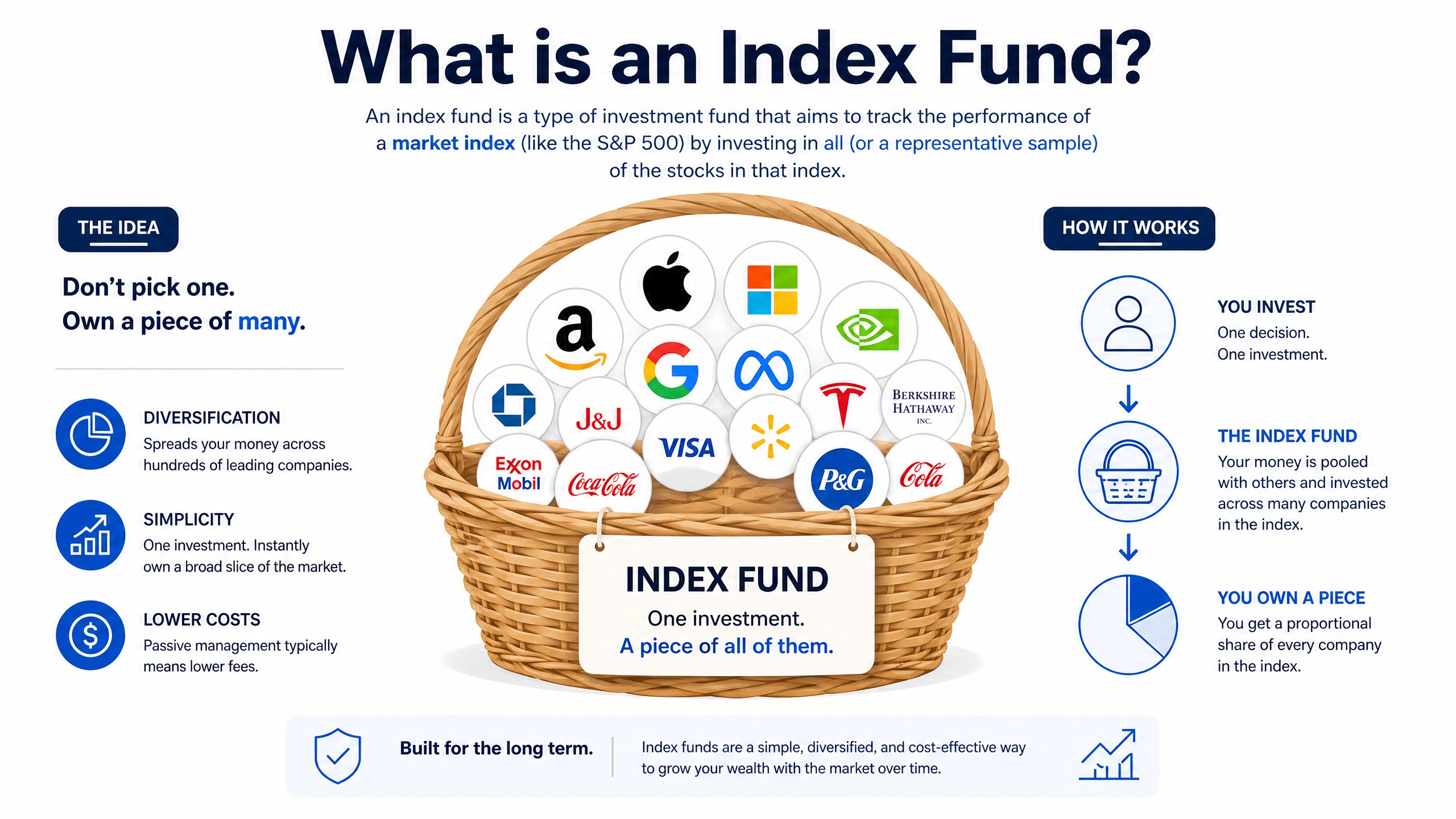
To understand an index fund, you must first understand what an “index” is. In the financial world, an index is simply a mathematical tracker—a standardized list of companies used to measure the overall health of a specific part of the economy.
The most famous index in the world is the S&P 500 (Standard & Poor’s 500). This is a list of the 500 largest, most profitable publicly traded companies in the United States (including giants like Apple, Microsoft, Amazon, and Johnson & Johnson).
An Index Fund is a massive pool of money, gathered from thousands of everyday investors, that is used to buy a tiny piece of every single company on that specific list.
The “Grocery Store” Analogy
Imagine you walk into a grocery store to buy fruit.
- Active Stock Picking: You spend hours inspecting every single apple, trying to guess which one is the absolute sweetest. If you pick a bad apple, your money is wasted.
- The Index Fund Approach: Instead of picking individual fruits, you simply buy a pre-packaged fruit basket that contains a small slice of every single fruit in the entire store. If the store thrives, your basket gains value.
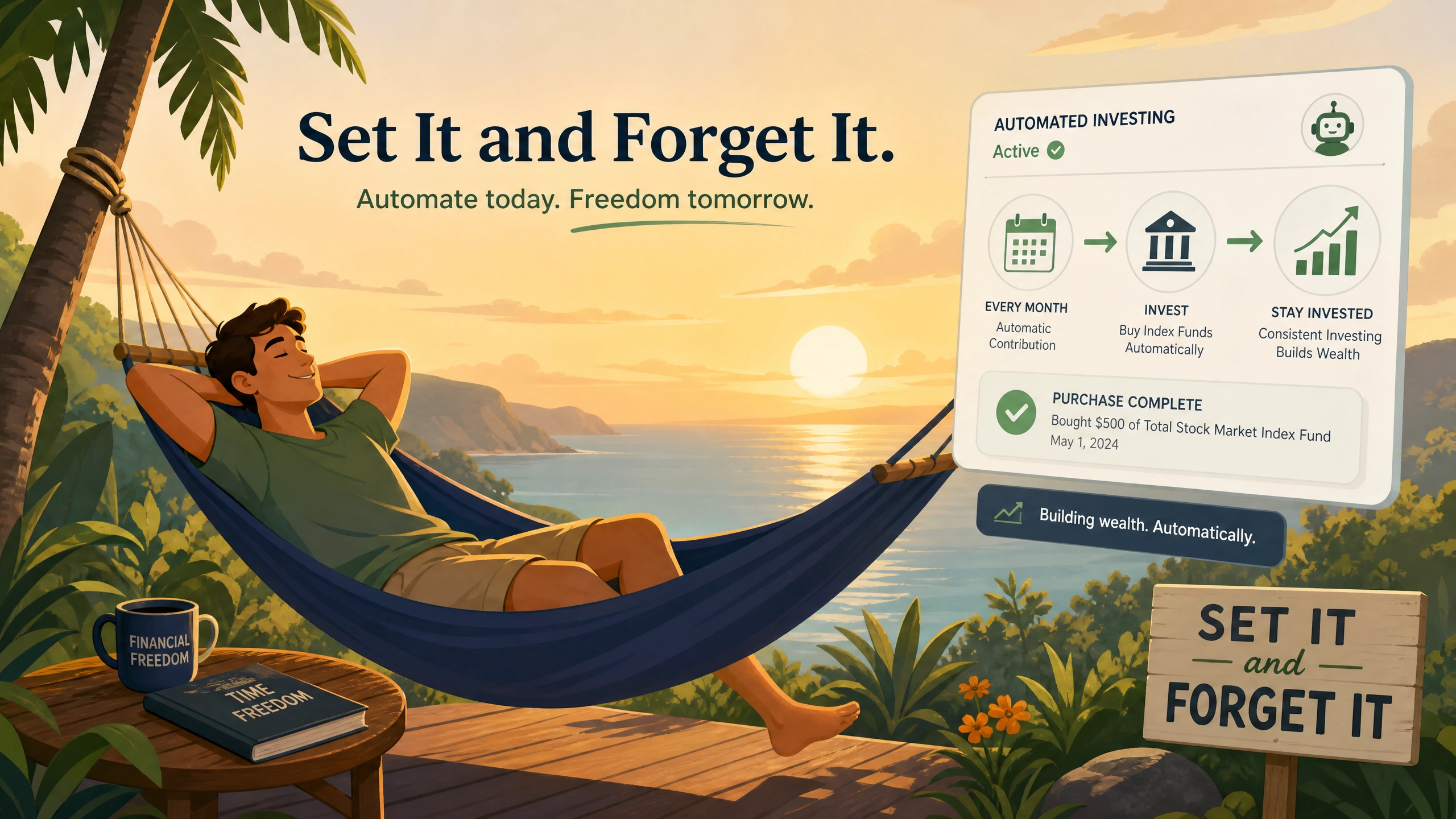
When you buy a single share of an S&P 500 Index Fund, you instantly become a fractional owner of the 500 most powerful corporations in America. It is the ultimate “set it and forget it” wealth-building tool.
2. A Brief History: The Revolution of Passive Investing
To truly appreciate the power of the index fund, you must understand the man who invented it: John “Jack” Bogle.
In the 1970s, the only way for a normal person to invest in a basket of stocks was to buy an “Actively Managed Mutual Fund.” You gave your money to a highly paid Wall Street fund manager, who wore an expensive suit and tried to guess which stocks would beat the market. For this “service,” the manager charged you massive fees, regardless of whether they made you money or lost it.
In 1975, Jack Bogle, the founder of the Vanguard Group, looked at the historical data and realized a shocking truth: virtually no active fund managers could consistently beat the market average over a 20-year period. Their massive fees were actually destroying their clients’ wealth.
Bogle created the world’s first index fund. Instead of paying a manager to guess which stocks would win, Bogle’s fund simply used a computer to automatically buy all the stocks in the S&P 500. Because there was no highly paid manager, the fees were microscopic.
Wall Street initially laughed at him, calling the invention “Bogle’s Folly” and claiming it was un-American to settle for “average” returns. Today, index funds manage trillions of dollars, and Jack Bogle is revered as a hero who saved the middle class billions of dollars in predatory fees.
3. The Unbeatable Mathematics of Low Fees (Expense Ratios)
The single greatest predictor of future investment success is not which stock you pick; it is how much you pay in fees. In the investing world, fees are known as the Expense Ratio.
An expense ratio is the percentage of your total investment that the brokerage takes every year to cover their administrative costs.
The Hidden Drain of High-Fee Funds
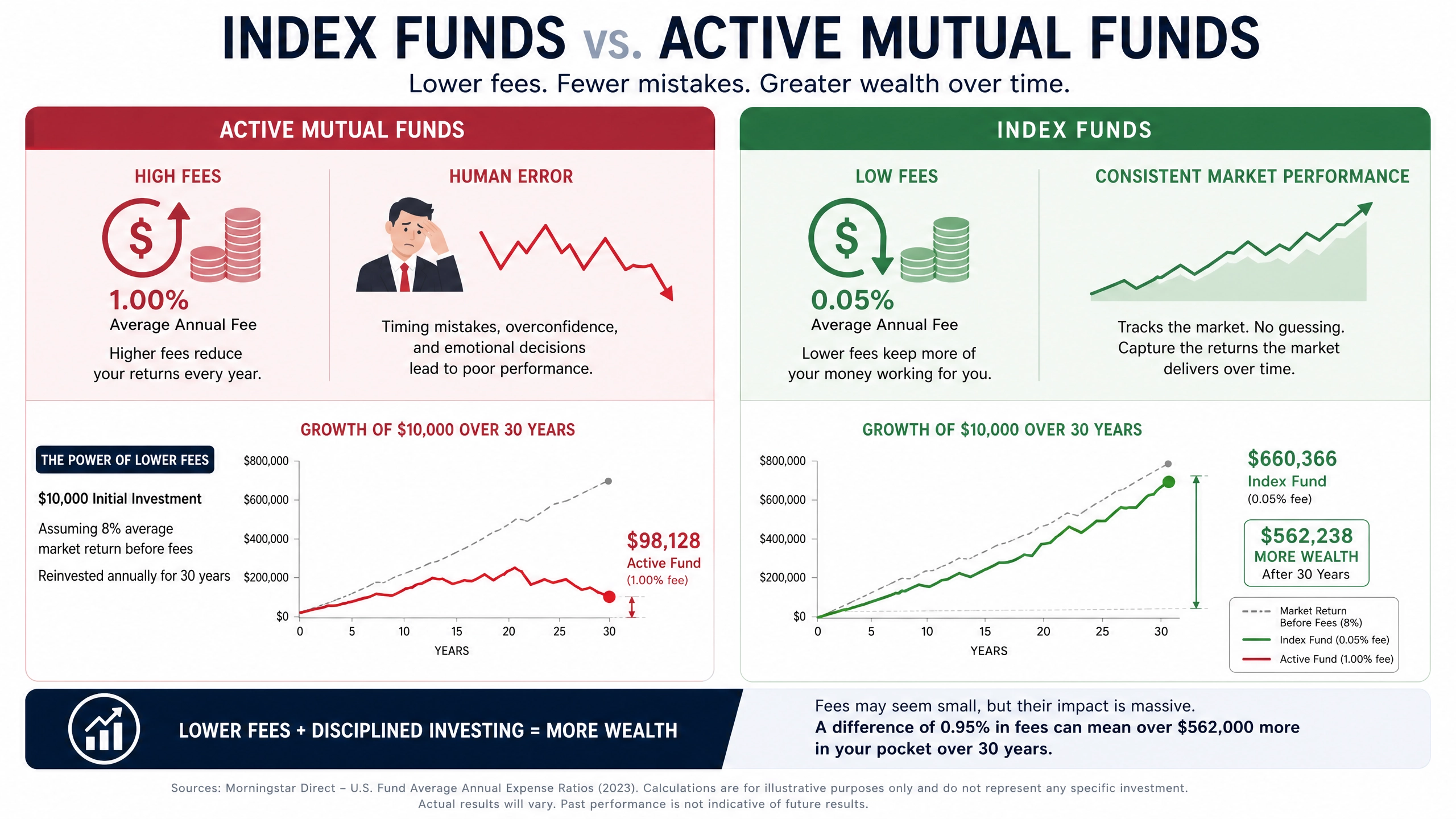
Assume you invest $10,000 in an actively managed mutual fund that charges a 1.5% expense ratio. That 1.5% might sound like a tiny, insignificant number. However, you pay that fee every single year on your total account balance.
If your money grows over 30 years, that 1.5% fee will devour a massive portion of your compound interest. It is not uncommon for a 1.5% fee to consume over 30% of your total potential lifetime returns. You are taking 100% of the risk, putting up 100% of the capital, but Wall Street is taking a third of your profit.
The Index Fund Advantage
Because an index fund is passively managed by an algorithm that simply tracks a list, the administrative costs are practically zero. A standard S&P 500 Index Fund from Vanguard, Fidelity, or Charles Schwab will have an expense ratio of roughly 0.03% to 0.04%.
To put that in perspective:
- In a 1.5% active fund, you pay $150 a year for every $10,000 invested.
- In a 0.03% index fund, you pay $3 a year for every $10,000 invested.
By switching to low-cost index funds, you keep hundreds of thousands of dollars of your own compound growth over a thirty-year investing horizon.
4. Instant Diversification: The Ultimate Risk Mitigator
The most common fear among beginner investors is the fear of total financial ruin. They remember the catastrophic collapses of giant corporations like Enron, Lehman Brothers, or Blockbuster Video, where individual shareholders lost everything.
Eliminating Single-Stock Risk
When you put all your money into a single company, you are exposed to Single-Stock Risk. If the CEO makes a terrible decision, or a new competitor invents a better product, your entire life savings can vanish.
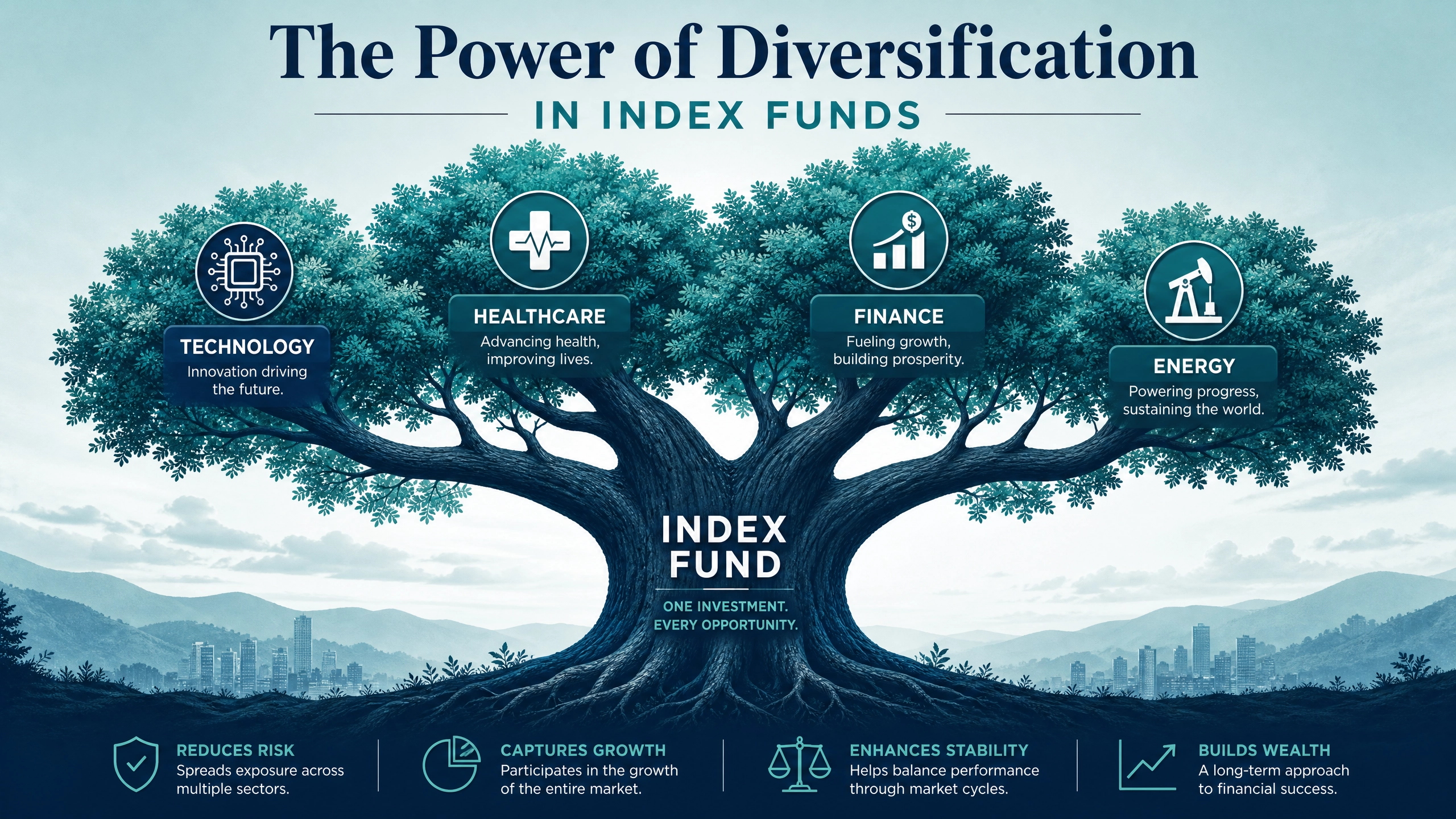
An index fund completely neutralizes single-stock risk through massive diversification. If you own an S&P 500 index fund, and one company within that index goes bankrupt, it has almost zero impact on your overall portfolio because the other 499 companies carry the weight.
The “Self-Cleansing” Mechanism
One of the most beautiful, automated features of an index fund is that it is inherently self-cleansing. The S&P 500 is a list of the 500 largest companies. If a company begins to fail and its value drops, it eventually gets kicked out of the index. It is immediately replaced by a new, rapidly growing company that has earned its spot. When you hold an index fund, you automatically own the winners, and the losers are automatically flushed out of your portfolio without you ever having to read an earnings report or click the “sell” button.
5. Index Funds vs. ETFs (Exchange-Traded Funds)
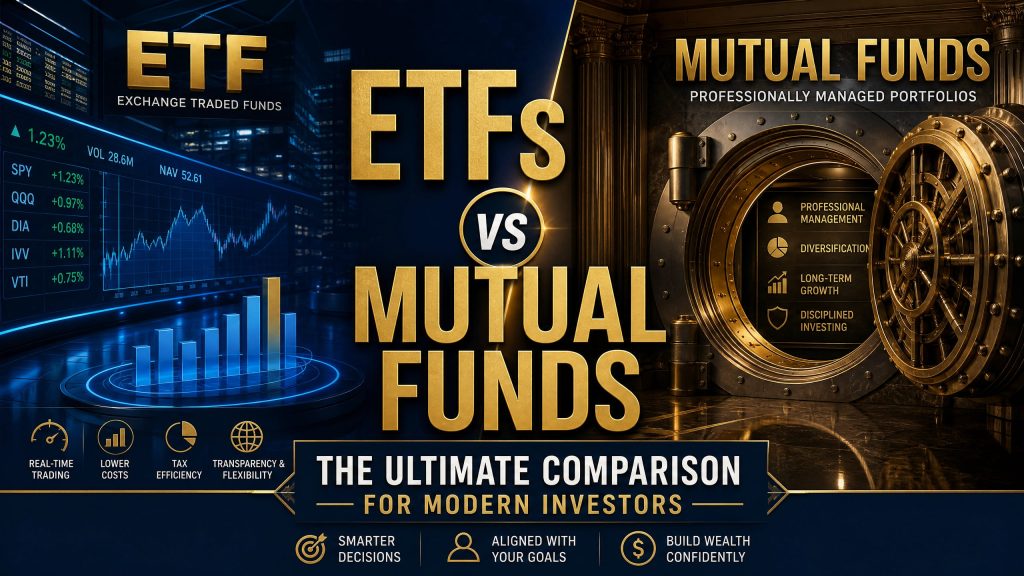
When you begin searching for index funds, you will immediately encounter the term ETF (Exchange-Traded Fund). This causes massive confusion for beginners, but the difference is purely mechanical.
Both a traditional Index Mutual Fund and an Index ETF hold the exact same basket of stocks. They simply trade differently.
The Mechanics of Trading
- Index ETF: An ETF trades on the stock market exactly like a regular stock. You can buy and sell it at any second during the trading day, and the price fluctuates by the minute. You buy them in “shares” (e.g., 1 share of an ETF might cost $400).
- Index Mutual Fund: These do not trade throughout the day. Regardless of what time you place your order, the transaction only executes once per day, after the market closes at 4:00 PM EST, at one final price. You do not buy “shares”; you simply invest a set dollar amount (e.g., you can invest exactly $150, and the computer will give you fractional shares).
Minimum Investment Requirements
Historically, traditional index mutual funds required large minimum deposits to open (often $3,000). ETFs only require you to have enough money to buy a single share (or even a fractional share for $5 on modern apps). Today, many brokerages have dropped their mutual fund minimums to zero, making both highly accessible.
| Feature | Index ETF | Traditional Index Mutual Fund |
|---|---|---|
| What does it track? | A specific market index (e.g., S&P 500) | A specific market index (e.g., S&P 500) |
| When can you trade it? | Anytime during market hours | Only once a day (after market close) |
| Pricing | Fluctuates by the second | Set once daily (Net Asset Value) |
| Minimum Investment | The price of one share (or less) | Can range from $0 to $3,000 |
| Best Used For | Total flexibility, transferring brokerages | Automated, set-and-forget monthly deposits |
Note: For the average long-term investor who sets up automatic monthly deposits, the difference between an ETF and a Mutual Fund version of the same index is practically irrelevant. Both will build massive wealth.
6. The “Holy Trinity” of Index Funds: What Should You Buy?
You do not need to own thirty different funds to be diversified. In fact, keeping your portfolio as simple as possible is the key to success. You can own the entire global economy using just three basic categories of index funds.
1. The S&P 500 Index Fund
This is the foundational rock of American investing. It tracks the 500 largest US companies. Because these are massive, multinational corporations, they generate revenue globally. Historically, this index has returned an average of about 10% per year over the last century (before adjusting for inflation). (Examples: VOO, FXAIX, SWPPX)
2. The Total US Stock Market Index Fund
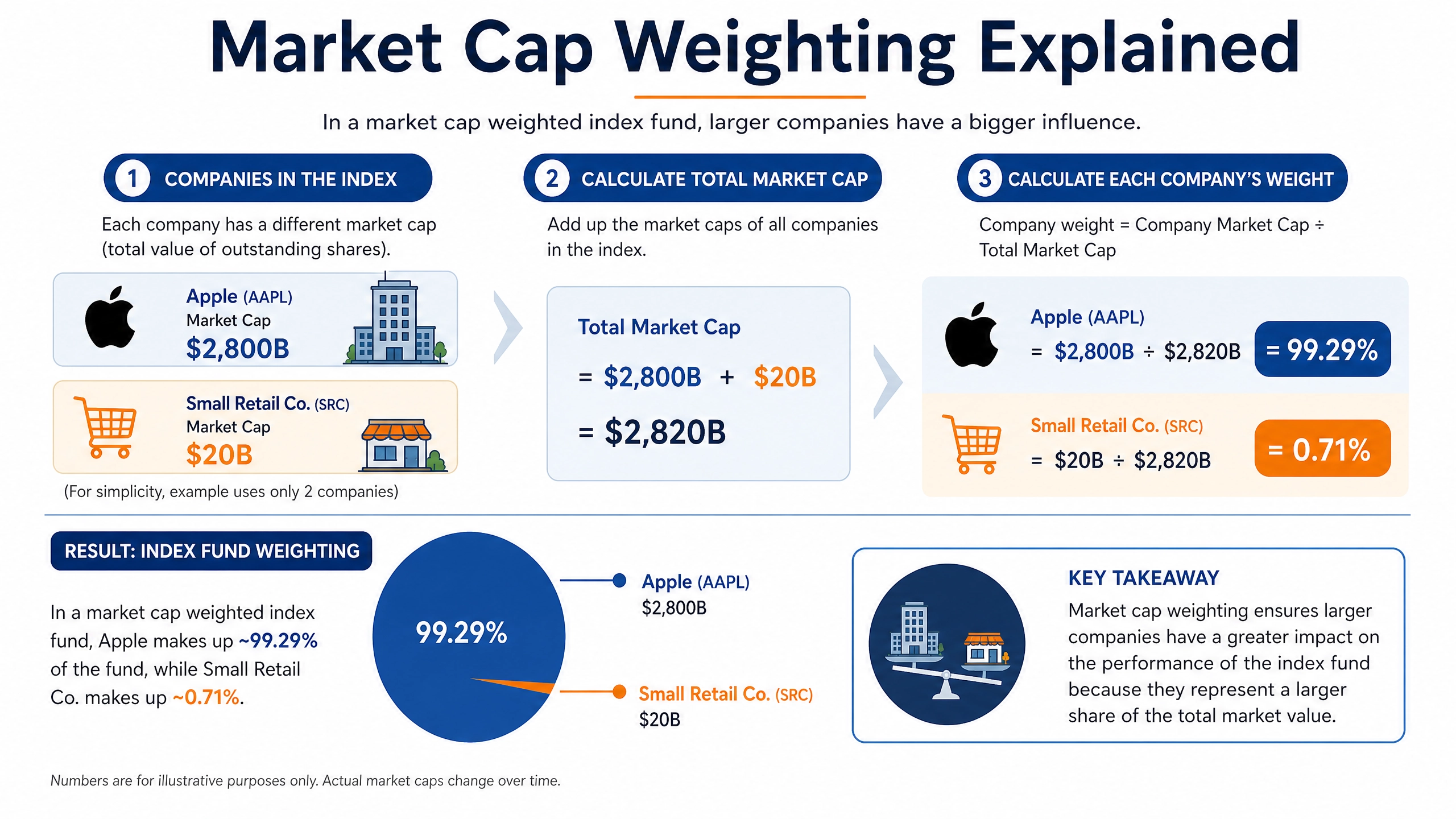
If you want even broader diversification, you can buy the Total Market index. Instead of just the top 500 companies, this fund buys a tiny piece of literally every single publicly traded company in the United States (roughly 3,800 to 4,000 companies). This gives you exposure to mid-sized and small “start-up” companies that might become the next tech giant. (Examples: VTI, VTSAX, FSKAX)
3. The Total International Stock Index Fund
To protect against the highly unlikely scenario that the United States economy underperforms for a decade, you can add an international index fund. This fund buys thousands of companies across Europe, Asia, and emerging markets, completely outside the US borders. (Examples: VXUS, VTIAX, FTIHX)
7. The Boglehead Philosophy: Building a “Three-Fund Portfolio”
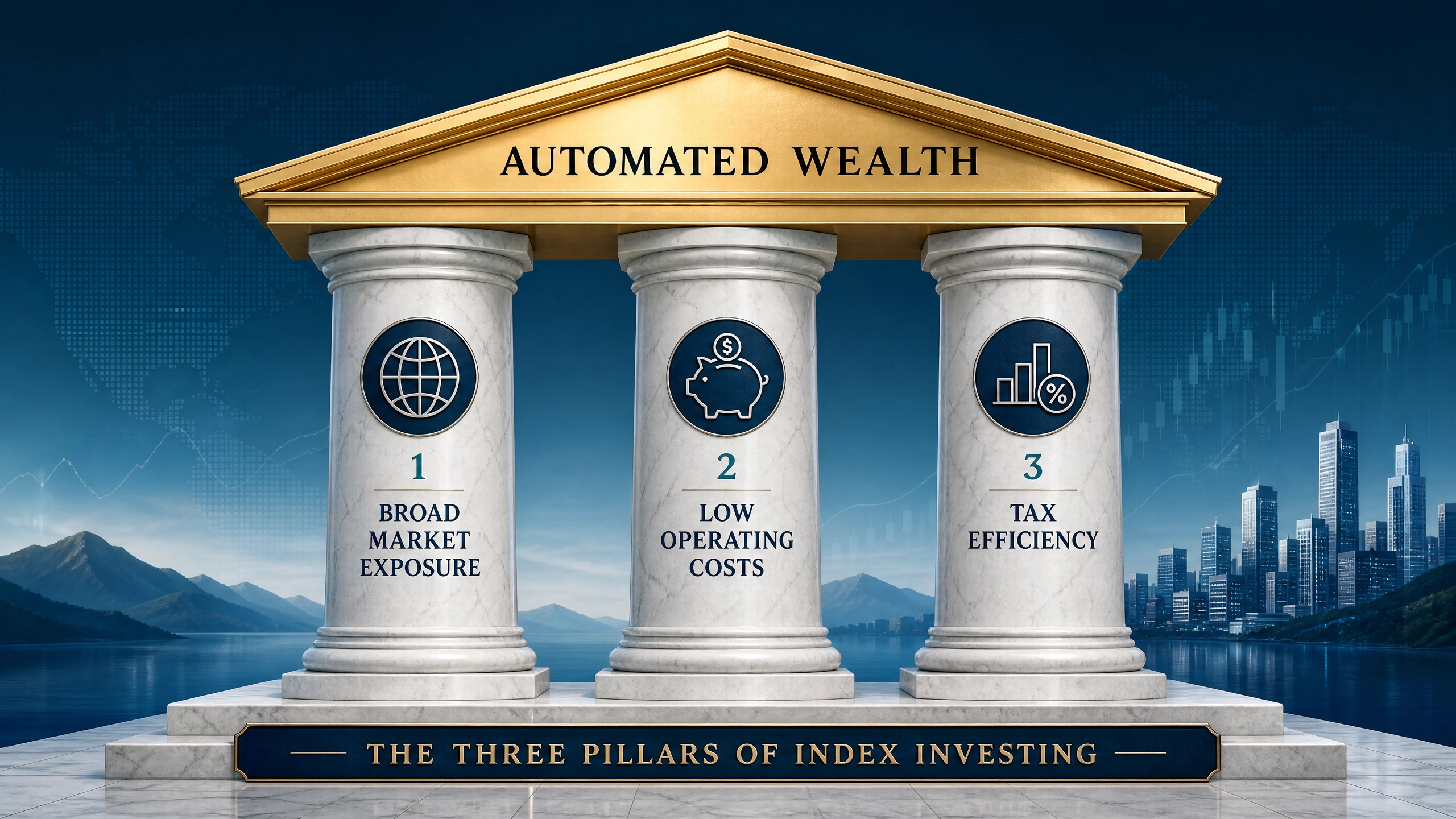
Named after Jack Bogle, the “Bogleheads” are a massive community of investors dedicated to extreme simplicity. They champion the legendary Three-Fund Portfolio.
This portfolio requires you to own only three index funds for the rest of your life:
- A Total US Stock Market Index
- A Total International Stock Index
- A Total US Bond Market Index
The Role of Bonds
While stock index funds provide massive growth, they are volatile. When the economy crashes, stock funds drop. Bond Index Funds act as the shock absorbers for your portfolio. A bond is essentially a loan you give to the government or a highly stable corporation. They pay you fixed interest and are far less volatile than stocks.
Asset Allocation Based on Age
Your “Asset Allocation” is the percentage of your money distributed between these three funds. The standard rule is based on your timeline to retirement.
- The Aggressive Accumulator (Age 20 – 40): You have decades to ride out market crashes. You need maximum growth.
- Example Portfolio: 70% US Stocks, 20% International Stocks, 10% Bonds (or even 0% Bonds).
- The Transition Phase (Age 40 – 55): You are getting closer to retirement and need to protect your wealth.
- Example Portfolio: 60% US Stocks, 15% International Stocks, 25% Bonds.
- The Retiree (Age 60+): You are actively withdrawing money to live on. A market crash would be devastating. You need safety and income.
- Example Portfolio: 40% US Stocks, 10% International Stocks, 50% Bonds.
8. Step-by-Step: How to Actually Buy Your First Index Fund
Many beginners get stuck at the actual execution phase. Here is the literal blueprint to get your money into the market today.
Step 1: Choose a Reputable Discount Brokerage
Do not use expensive financial advisors or high-fee banks. Open a free, online brokerage account. The “Big Three” that are universally recommended for their zero-fee structures and massive index fund selections are Vanguard, Fidelity, and Charles Schwab.
Step 2: Open and Fund the Account
Navigate to their website and open a standard Brokerage Account (or a Roth IRA if you are saving specifically for retirement). Link your personal checking account and transfer your initial cash deposit (e.g., $500) into the brokerage.
Step 3: Execute the Trade (The Critical Step)
Warning: When you transfer money into a brokerage, it does NOT automatically invest itself. It just sits in a “cash settlement” account earning almost nothing. You must manually execute a trade.
- Log into your account and click “Trade” or “Transact.”
- Enter the ticker symbol of the index fund you chose (e.g., VOO for the Vanguard S&P 500 ETF).
- Select “Buy.”
- Enter the dollar amount you wish to invest.
- Hit submit. Congratulations, you now own a piece of the global economy.
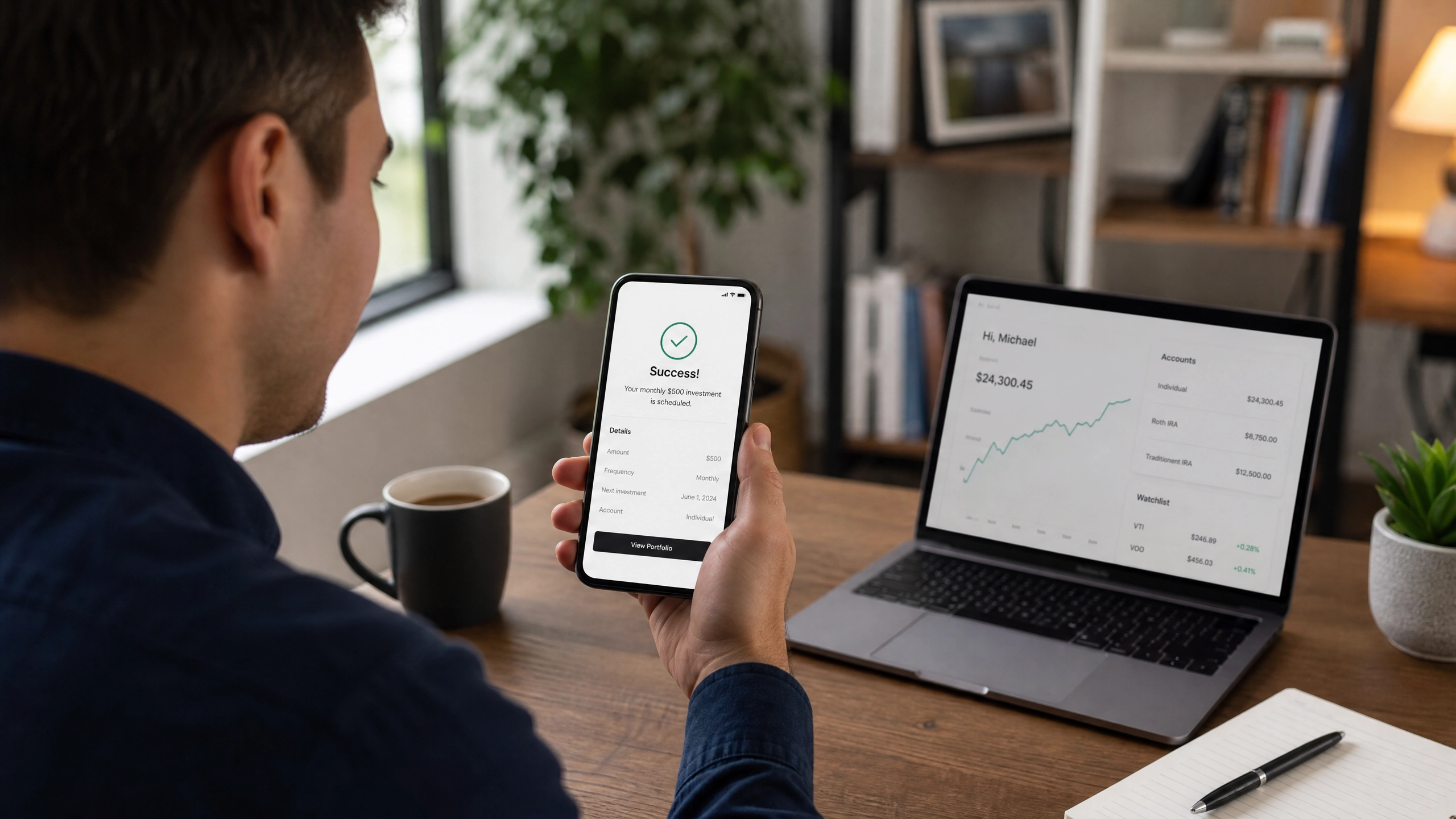
Step 4: Set Up Automated Investing
To guarantee success, remove your own willpower from the equation. Most brokerages allow you to set up “Automatic Investments.” Instruct the brokerage to automatically pull $200 from your checking account on the 1st of every month and automatically use it to buy your chosen index fund.
9. The Golden Rules of Index Fund Psychology
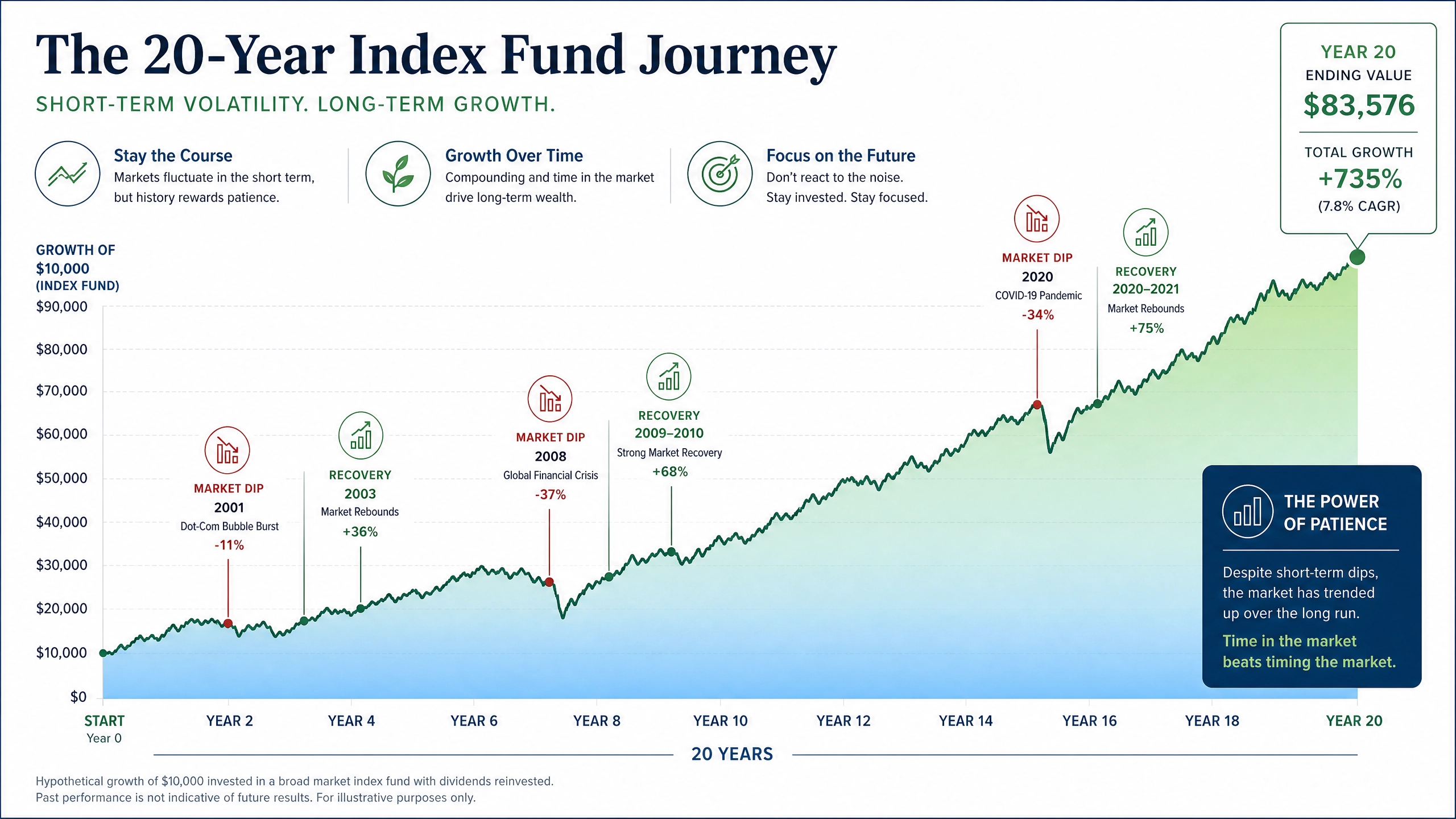
The mathematics of index fund investing are flawless. The only way you can lose over a 30-year period is if you sabotage your own portfolio through emotional panic.
Ignore the Financial News
The financial media (CNBC, Bloomberg, Yahoo Finance) exists to sell advertising space, and they do that by generating panic. They will constantly tell you that a market crash is imminent. Ignore them entirely. When the market crashes by 20%, do not check your portfolio. Do not sell your index funds. The market has survived World Wars, pandemics, and Great Depressions, and it has always rebounded to reach new all-time highs.
Embrace Dollar-Cost Averaging (DCA)
By investing a fixed amount of money every single month regardless of what the market is doing, you are utilizing Dollar-Cost Averaging. When the stock market is hitting all-time highs, your $200 buys fewer shares. When the stock market crashes and everyone is panicking on the news, your $200 automatically buys more shares at a massive discount. DCA turns market crashes into automated, highly profitable buying opportunities.
10. Frequently Asked Questions (FAQ)
Can I get rich quickly with an index fund?
Absolutely not. An index fund is not a lottery ticket or a speculative cryptocurrency. It is a slow, relentless engine of wealth creation. It utilizes compound interest over decades. If you are looking to double your money in a week, the stock market is the wrong place; you are looking for a casino.
Do index funds pay dividends?
Yes! When you own an index fund, you own a piece of hundreds of companies. Many of those companies pay quarterly dividends (sharing their cash profits with shareholders). Your index fund will collect all those thousands of tiny dividend payments and deposit them into your account. Crucial advice: Make sure you select the “Reinvest Dividends” (DRIP) option in your brokerage settings. This automatically uses your dividend cash to buy more shares of the index fund, aggressively accelerating your compound growth.
What happens if the S&P 500 goes to zero?
If the S&P 500 index fund drops to absolute zero, it means the 500 largest companies in America—including the banks, the power grid, the food supply chain, and the tech infrastructure—have completely ceased to exist. If this apocalyptic scenario occurs, your index fund balance will be the least of your concerns; money will be worthless, and you will be trading canned goods for survival. In any normal economic reality, the index will always recover.
Can I invest in index funds if I don’t live in the US?
Yes. Investors globally can access index funds. Most major international brokerages (like Interactive Brokers) offer access to US-based ETFs like VOO or VTI. Additionally, many countries have their own specific index funds (like UCITS ETFs in Europe) that track the S&P 500 or global markets while complying with local tax and regulatory laws.
Author’s Note: The Ultimate Financial Life Hack
The financial services industry spends billions of dollars every year trying to convince you that you are not smart enough to manage your own money. They want you to believe that you need their complex algorithms, their expensive active managers, and their high-fee mutual funds to survive the market.
The index fund is the ultimate financial life hack that breaks this predatory cycle. It democratizes wealth.
By purchasing a low-cost, broad-market index fund, you are essentially betting that human innovation, corporate efficiency, and global commerce will continue to grow over the next few decades. It is a bet that has never lost over any 20-year rolling period in modern financial history.
Stop analyzing individual balance sheets, stop listening to your friend’s “hot stock tip,” and stop trying to time the next market crash. Open your brokerage account, set up your automated monthly transfer into an S&P 500 or Total Market index fund, and walk away. Go focus your time on your career, your family, and your passions, while the relentless, churning engine of global capitalism quietly builds a fortress of multi-generational wealth in your background.