
The Rise of Neobanks How Digital Banking is Replacing Traditional Branches
For centuries, the concept of banking was inextricably linked to physical architecture. Vaults of solid steel, marble pillars, mahogany desks, and long lines of customers waiting to speak with a human teller defined the financial experience. A bank’s power and trustworthiness were directly correlated to the physical footprint it maintained across a city.
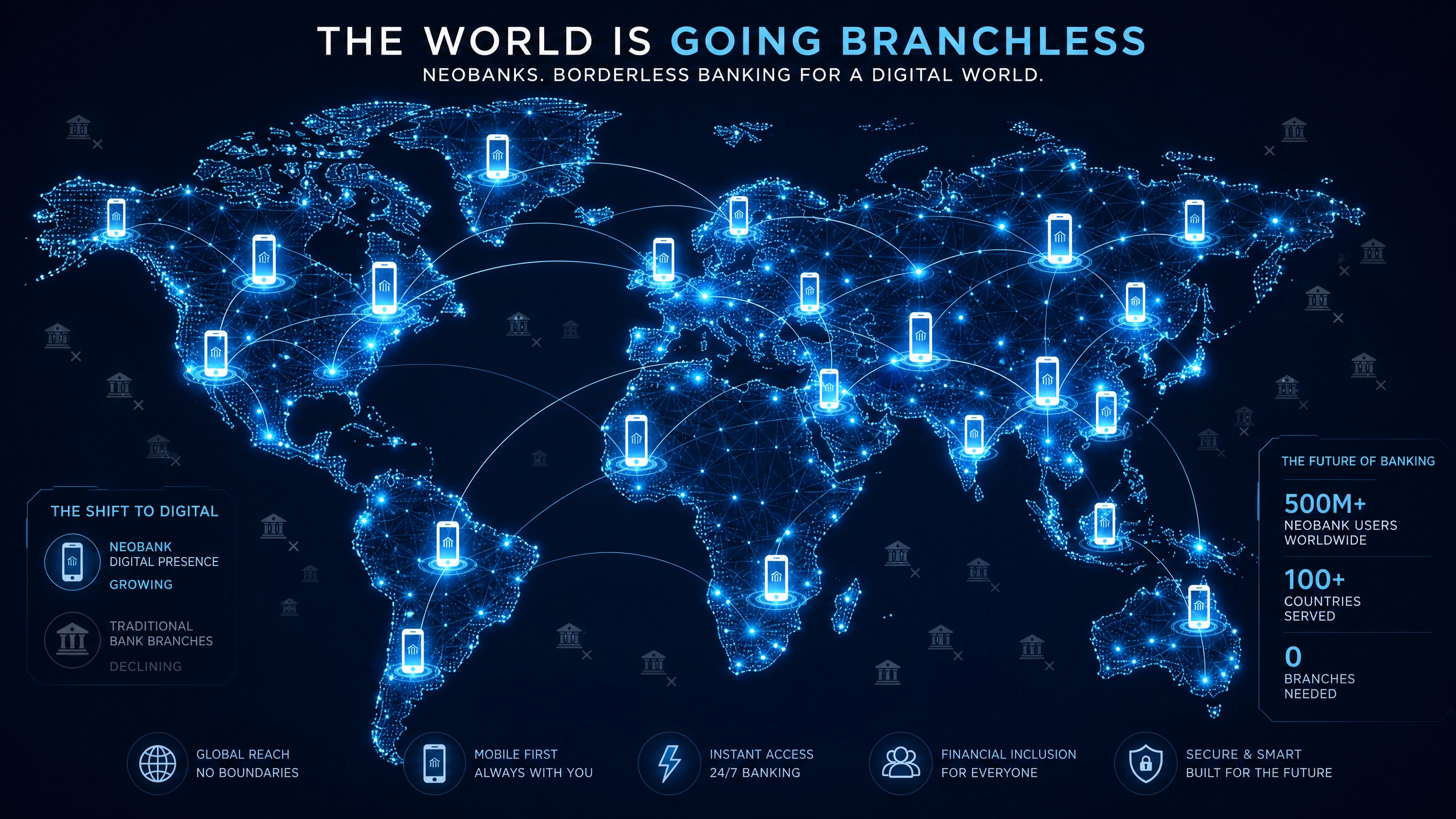
However, over the last decade, a silent but aggressive revolution has completely fractured this traditional model. A new breed of financial institutions has emerged, operating entirely without physical branches, physical vaults, or human tellers. They exist solely as lines of code, cloud-based servers, and sleek interfaces on your smartphone.
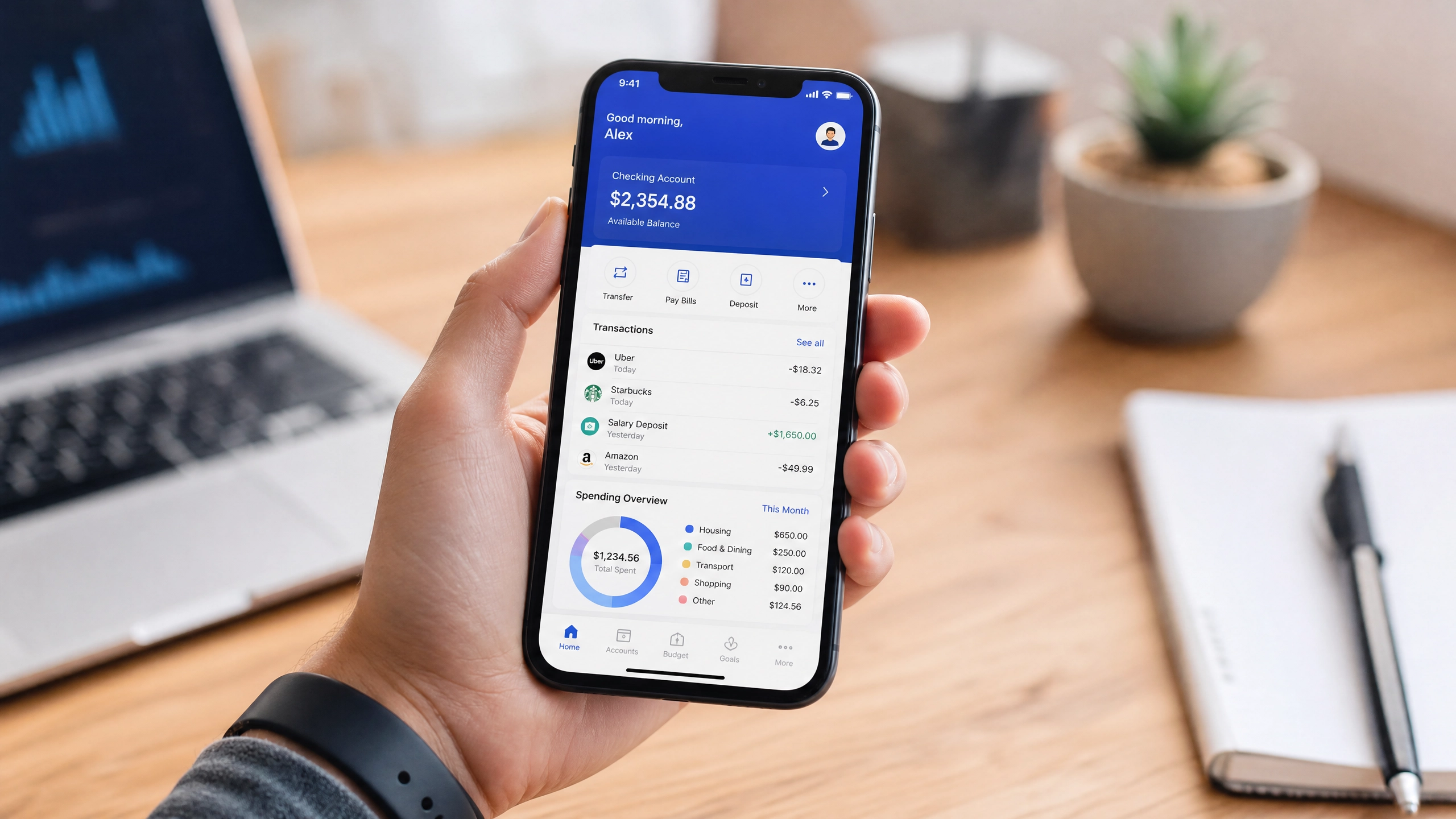
These are the Neobanks.
What began as a niche experiment targeting tech-savvy millennials has aggressively matured into a trillion-dollar industry. Companies like Chime, Revolut, Monzo, and N26 are no longer simply “startups”; they are heavily capitalized financial juggernauts boasting tens of millions of customers globally.
If you are wondering whether you still need to pay arbitrary maintenance fees to a legacy bank just for the privilege of keeping your money in a checking account, the answer is rapidly becoming a resounding “no.” This comprehensive guide will deeply analyze the mechanics of the Neobank revolution. We will explore how they operate with microscopic overhead, how they are forcing traditional banks to panic and adapt, their unique revenue models, and whether you should transition your primary financial life into the cloud.
1. What Exactly is a Neobank? (The Core Mechanics)
To understand the revolution, we must define the terminology. While the terms “Digital Bank” and “Neobank” are often used interchangeably, there is a distinct structural difference in the financial world.
The True Neobank Definition
A Neobank is a financial technology (FinTech) company that offers banking services exclusively through digital platforms (mobile apps and websites). They have zero physical branches.
Crucially, in many jurisdictions (especially in the United States), most Neobanks are not technically “banks” in the legal sense. They are technology companies that build the software, the user interface, and the branding. To hold your money and provide federal insurance (like FDIC insurance in the US), they partner with underlying, traditional sponsor banks (such as The Bancorp Bank or Stride Bank).
- The Front-End: The Neobank builds a beautiful, frictionless, AI-driven mobile app that you interact with daily.
- The Back-End: The partner bank holds the actual cash, manages the regulatory compliance, and provides the federal deposit insurance.
(Note: In Europe, the regulatory environment is different. Companies like Revolut, Monzo, and N26 have successfully acquired their own full banking licenses, allowing them to operate completely independently without a sponsor bank).
Digital Banks vs. Neobanks
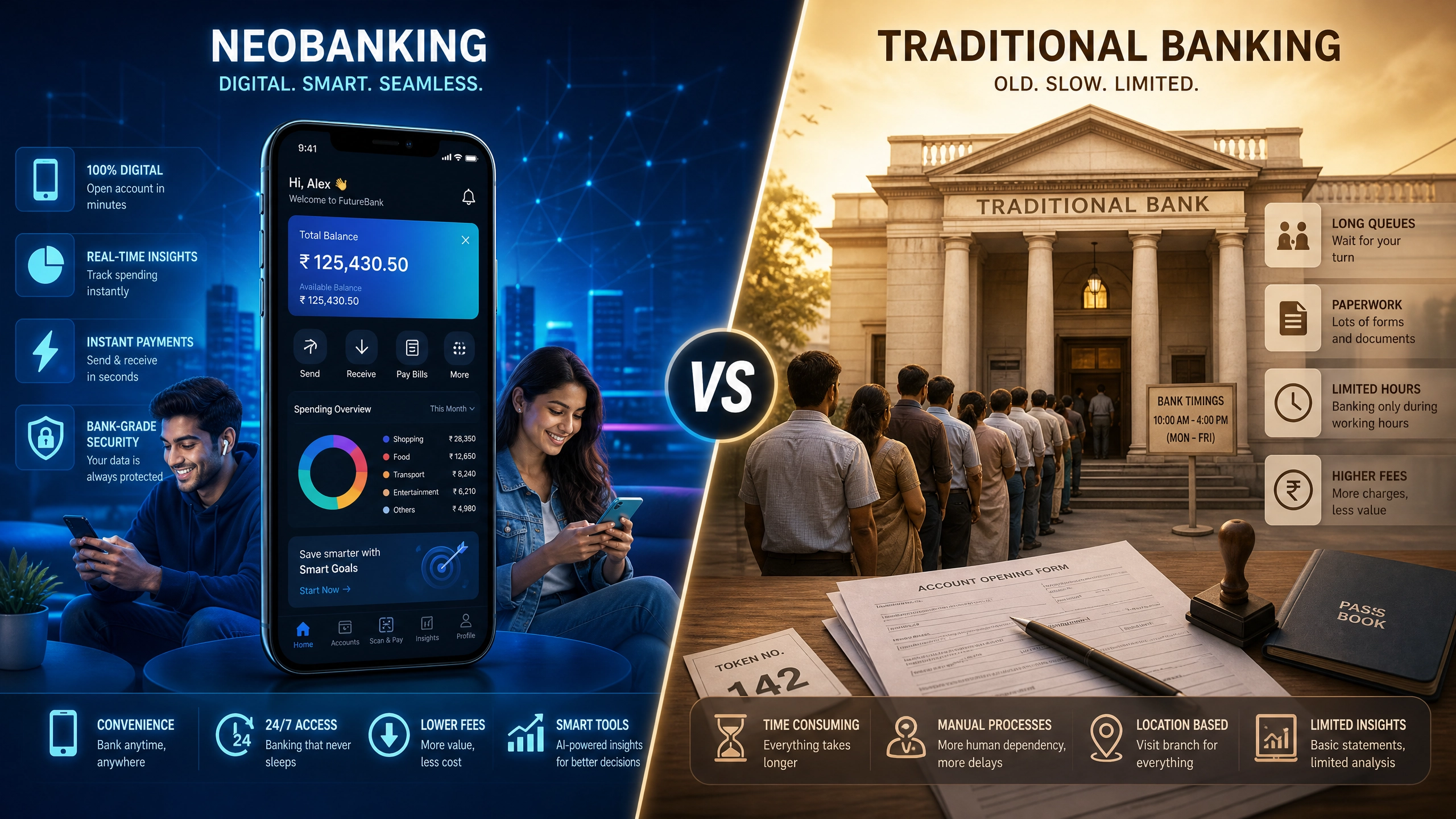
It is vital not to confuse a Neobank with a traditional bank’s digital app. When you download the Chase or Bank of America app, you are using a Digital Bank. It is simply a digital extension of a legacy institution that still operates thousands of expensive physical branches. A Neobank has no physical legacy architecture to support.
2. The Unbeatable Economic Advantage: Why Neobanks Win
How did relatively young startups manage to steal millions of customers away from banks that have existed for a hundred years? The answer lies in structural economics and the relentless optimization of customer acquisition.
1. The Destruction of Overhead Costs
The legacy banking model is catastrophically expensive. A traditional bank must pay for commercial real estate in prime city locations, electricity, security guards, branch managers, and tellers.
Neobanks operate in the cloud. By eliminating the physical branch network, their operational expenditure (OpEx) drops dramatically. Industry studies show that Neobanks can operate at roughly 60% to 70% cheaper than traditional legacy banks on a daily basis.
2. Passing the Savings to the Consumer
Because Neobanks do not have to pay rent on a physical branch, they take those massive savings and use them as a weapon against traditional banks. This is why Neobanks can offer:
- Zero Monthly Maintenance Fees: You do not have to maintain a minimum balance to keep your account free.
- Zero Overdraft Fees: Features like Chime’s “SpotMe” allow users to overdraw their accounts up to a certain limit without being hit with a predatory $35 overdraft penalty.
- Higher APY on Savings: Because their overhead is so low, they can offer significantly higher Annual Percentage Yields (APY) on savings accounts compared to the 0.01% offered by legacy institutions.
3. The Superior User Experience (UX/UI)
Traditional banks treat their software as a necessary evil—an add-on to their physical branch. Neobanks treat their software as their entire product. Opening a traditional bank account often requires walking into a branch with physical identification documents and signing paper forms. Neobanks utilize AI-driven onboarding. You can verify your identity using a smartphone camera and have a fully functional checking account and virtual debit card ready to use in under three minutes.

3. How Do Neobanks Make Money Without Charging Fees?
If a Neobank does not charge you a $12 monthly maintenance fee, and they do not charge you a $35 overdraft fee, how do they generate billion-dollar valuations? They monetize the backend of the global financial system through three primary engines.
Engine 1: The Interchange Fee (The Primary Driver)
This is the lifeblood of the American Neobank model (like Chime). Every time you swipe a debit or credit card at a merchant (like buying groceries or a coffee), the merchant must pay a processing fee to the card network (Visa/Mastercard) and the issuing bank. This is called the “Interchange Fee” or “Swipe Fee.”
Because Neobanks partner with smaller, regional sponsor banks, they are legally permitted (under the Durbin Amendment to the Dodd-Frank Act) to charge merchants significantly higher interchange fees than massive legacy banks. Every time you buy a coffee with your Neobank debit card, the Neobank takes a tiny percentage of that transaction from the merchant. You pay nothing extra, but the Neobank generates massive revenue simply by encouraging you to use their card for all your daily spending.
Engine 2: The “Freemium” Subscription Model
European Neobanks (like Revolut, Monzo, and N26) have heavily popularized the “Netflix of Banking” model. They offer a completely free basic checking account to get you into their ecosystem. However, if you want premium features—such as travel insurance, higher ATM withdrawal limits abroad, crypto trading capabilities, or metal debit cards—you must pay a monthly subscription fee (e.g., $9.99 or $16.99 a month). This generates highly predictable, recurring revenue that investors love.
Engine 3: Lending and Credit Expansion
As Neobanks mature, they realize that pure transaction fees are not enough to achieve massive profitability. To truly compete with traditional banks, they must lend money. Neobanks are actively expanding into high-margin products like personal loans, credit building tools, and “Buy Now, Pay Later” (BNPL) integrations. By analyzing your real-time spending data, their AI algorithms can instantly pre-approve you for a loan with much lower risk than a traditional underwriter.

4. The Global Titans of the Neobank Ecosystem
The global market is dominated by a few massive players, each with a slightly different strategy tailored to their specific regional regulations.
Chime (The American Giant)
Chime is the undisputed king of the US Neobank market. Instead of chasing high-net-worth individuals, Chime built its empire by explicitly targeting the “underbanked” middle and working classes.
- The Strategy: They aggressively marketed the elimination of predatory overdraft fees and introduced the “Get Paid Early” feature, allowing users to access their direct deposit paychecks up to two days before traditional banks release the funds.
- The Scale: As of 2025/2026, Chime surpassed 25 million account holders and generated over $2 billion in annual revenue, proving that serving the average consumer without fees is a massively profitable business model.
Revolut (The Global Super-App)
Born in the UK, Revolut operates on an entirely different philosophy. They are not just building a checking account; they are building a global “Financial Super-App.”
- The Strategy: Revolut wants you to run your entire financial life through their interface. Their app offers multi-currency accounts, instant global money transfers with real exchange rates, stock trading, cryptocurrency integration, and business accounts.
- The Scale: Revolut has aggressively expanded globally, surpassing an astonishing 70 million customers by 2026, launching in new markets at a relentless pace and securing full banking licenses across Europe.
Monzo & N26 (The Lifestyle Banks)
Monzo (UK) and N26 (Germany) revolutionized the visual and psychological aspect of banking.
- The Strategy: They introduced the iconic bright coral and transparent debit cards. More importantly, they gamified budgeting. Their apps instantly categorize your spending, send real-time push notifications the exact second you buy something, and allow you to set strict limits on dining out or shopping. They transformed banking from a boring chore into an engaging lifestyle tool.

5. Traditional Banks Strike Back: The Convergence of 2026
The narrative that “Neobanks will completely destroy traditional banks” is a vast oversimplification. Legacy banks (like JPMorgan Chase, Bank of America, and HSBC) did not simply roll over and accept defeat.
The Incumbent Counter-Attack
Traditional banks have watched the Neobank playbook and are aggressively adapting. They are pouring billions of dollars into their own digital infrastructure.
- Closing the Tech Gap: Legacy banking apps are vastly superior today than they were five years ago. They have copied Neobank features like real-time spending alerts, Zelle integrations for instant peer-to-peer transfers, and AI budgeting tools.
- The Launch of “Flanker Brands”: Some massive banks have created their own standalone, digital-only subsidiary brands to directly compete for the younger demographic without cannibalizing their core high-net-worth clients.
The Neobank Profitability Problem
While Neobanks are masters of customer acquisition, they face a severe challenge: Profitability. Acquiring a new customer is expensive (marketing, onboarding). If a customer only uses a Neobank as a secondary account to buy coffees, the Neobank loses money. The ultimate battle in 2026 and beyond is the fight to become the “Primary Account.” A Neobank only reaches massive profitability when a user deposits their full salary into the app and uses it to pay their rent, auto loans, and daily expenses.

6. Tokenization and AI: The Future of Digital Banking
The Neobank of 2026 is rapidly evolving beyond basic checking accounts. The integration of advanced technologies is changing the foundational architecture of money.
Agentic AI and Autonomous Banking
We are moving away from reactive banking (where you look at your balance) to proactive, Agentic AI banking. Future Neobank apps will act as autonomous financial managers. If you have an upcoming large bill, the AI agent will automatically move funds from your savings, analyze your subscription data to negotiate a lower internet bill, and instantly route your idle cash into a higher-yielding money market fund overnight—all without human intervention.
Real-World Asset (RWA) Tokenization
The integration of blockchain technology is no longer about trading speculative crypto tokens; it is about infrastructure. Neobanks are pioneering the use of tokenized real-world assets. In the near future, you will not just hold cash in your Neobank; you might hold a tokenized fractional share of a commercial real estate building, or tokenized US Treasury bonds, trading instantly on digital rails with zero settlement delays.
7. Comparative Matrix: Neobank vs. Traditional Bank
Use this rapid-reference matrix to determine if you are ready to transition your financial life fully into the cloud.
| Feature / Capability | The Neobank (e.g., Chime, Revolut) | The Traditional Bank (e.g., Chase, BofA) |
|---|---|---|
| Physical Branches | Zero. 100% Digital operation. | Thousands of physical locations. |
| Monthly Maintenance Fees | Almost entirely non-existent. | Common, unless a high minimum balance is kept. |
| Overdraft Fees | Often waived or protected (up to limits). | Highly punitive (often $35+ per transaction). |
| Cash Deposits | Difficult. Requires using partner ATMs or retail stores (often with a fee). | Effortless. Walk into any branch or native ATM. |
| Complex Lending (Mortgages) | Extremely rare. Focused on short-term credit. | The core business model. Highly equipped for massive loans. |
| Customer Service | In-app chat, AI bots, sometimes phone support. | In-person branch managers, dedicated relationship bankers. |
| Best Target Demographic | Digital natives, freelancers, people tired of nickel-and-dime fees. | High-net-worth individuals, businesses needing cash handling, conservative savers. |

8. The Risks: Is Your Money Safe in a Neobank?
The most common anxiety preventing older generations from adopting Neobanks is the fear of total loss. “If the app crashes, does my money disappear?”
The absolute rule: If you are a US citizen, you must ensure the Neobank you choose states explicitly on its website that deposits are “FDIC Insured through [Partner Bank Name].”
As long as that FDIC insurance is active, your money is backed by the full faith and credit of the United States government up to $250,000. If the Neobank goes bankrupt, or if its partner bank fails, the federal government steps in to make you whole. Your money is mathematically just as safe in Chime as it is in a vault at Wells Fargo.
However, customer service during a crisis is the real risk. If a traditional bank freezes your account due to suspected fraud, you can walk into a physical branch and show your ID to a human to resolve it. If a Neobank freezes your account, you are entirely reliant on digital customer support tickets, which can sometimes be frustrating and slow to resolve.

9. Frequently Asked Questions (FAQ)
Will traditional banks completely disappear?
No. Traditional banks still control the vast majority of global wealth, complex corporate lending, and commercial real estate financing. The future is convergence, not total replacement. Traditional banks will continue to digitize, while Neobanks will seek full banking licenses to offer more complex lending products.
Can I use a Neobank as my primary business account?
Absolutely. Companies like Revolut Business and Monzo offer incredible B2B solutions. Neobank business accounts are highly popular among freelancers, LLCs, and digital startups because they integrate flawlessly with accounting software (like QuickBooks or Xero), offer instant virtual team cards, and manage multi-currency payrolls efficiently.
Why do some Neobanks charge subscription fees?
The subscription model (Premium or Metal tiers) is a way for Neobanks to diversify their revenue away from just swipe fees. In exchange for a monthly fee, they bundle services that frequent travelers or heavy spenders find valuable, such as zero-fee foreign exchange, airport lounge access, and premium travel insurance, which would cost significantly more if purchased separately.

Author’s Note: The Democratization of Capital
The financial services industry has historically thrived on friction and opacity. For decades, traditional banks operated on a model that penalized the poorest customers with maintenance and overdraft fees, while rewarding the wealthiest customers with waived fees and premium service.
The Neobank revolution is not just a technological shift; it is a democratization of capital.
By utilizing cloud computing, AI onboarding, and microscopic overhead costs, Neobanks have proven that a financial institution does not need to punish its users to achieve a multi-billion dollar valuation. They have forced the slow, lumbering giants of legacy banking to drop their fees and improve their digital offerings simply to survive.
Transitioning your daily spending to a Neobank is no longer an experimental risk for early tech adopters; it is a highly rational financial decision. Keep your traditional bank for complex mortgages or depositing physical cash, but route your daily life through a Neobank. Take advantage of the zero fees, the automated budgeting tools, and the frictionless UX. In the modern economy, loyalty to a brick-and-mortar building is an expensive nostalgia you can no longer afford.